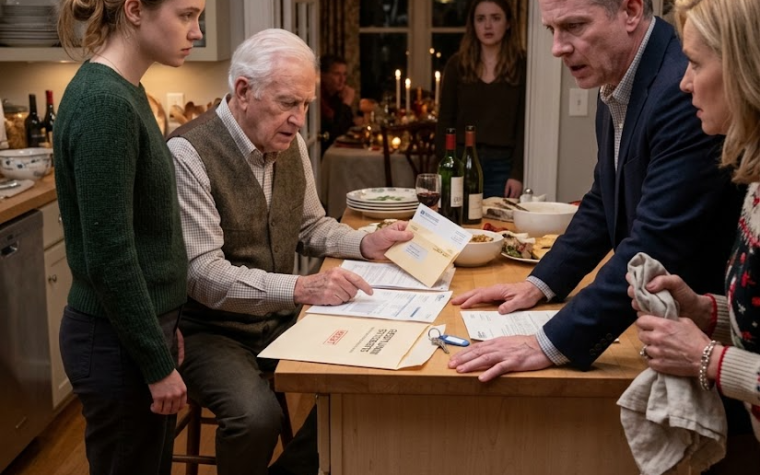
His expression changed.
Mom looked at him.
Dad looked at him too.
For the first time, Brandon had no joke ready.
Mercer said, “The buyer listed in the contract received its earnest-money funds from an account under your control.
Would you like to explain that?”
Brandon’s mouth opened, then closed.
Mom answered for him.
“It was an investment.”
“In his sister’s inheritance?” Mercer asked.
“It was a family arrangement.”
That phrase made something in me settle.
Family arrangement.
That was what Mom called every decision where Brandon received something and I was expected to understand.
College help when he changed majors three times.
A car after he wrecked the first one.
Rent when he quit a job because his manager was disrespectful.
Now Grandma’s house.
Brandon finally spoke.
“I was going to take over the property through the company.
Mom would get the sale proceeds.
She was going to clear some of my debt.
I’d handle the house after that.”
“You told me yesterday I didn’t need the house,” I said.
“You don’t.”
“But you do?”
“That’s not what I said.”
“It’s exactly what you did.”
Mercer asked one more question.
“Did Alyssa consent to any of this?”
Nobody answered.
Mom crossed her arms.
“She would never have agreed.”
“That,” Mercer said, “is why consent exists.”
Mom’s face hardened.
“You people are turning paperwork into a weapon.”
I looked past her toward the oak branches moving above the street.
“No.
Grandma used paperwork as a lock because she knew you would try the door.”
Mom went pale.
That was when I understood the underlined sentence in Grandma’s letter.
If anyone tries to pressure you, sell without your consent, or use family guilt to take this house, call Mr.
Mercer immediately.
Grandma had not written it because she was paranoid.
She had written it because she knew the pattern.
Maybe she did not know the exact scheme.
Maybe she never imagined a posthumous power of attorney, a hidden buyer entity, or Brandon using a company to position himself on the other side of the transaction.
But she knew her daughter.
She knew her grandson.
And she knew me well enough to understand my greatest weakness was not ignorance.
It was the amount of cruelty I would tolerate before allowing someone else to feel uncomfortable.
Mercer ended the porch conversation after Dad agreed to provide a written statement about what he had signed and why.
Mom called that betrayal.
Dad did not answer her.
For once, his silence landed on the other side.
The next several weeks were less dramatic than that morning and more consequential.