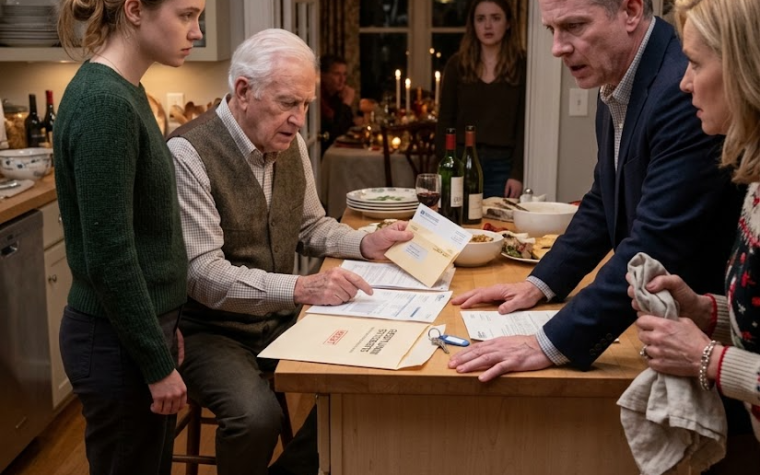
My mother read the first sentence of the legal notice twice.
Then she looked at the attached deed and whispered, “This isn’t possible.”
Steven was standing behind her chair.
Bobby leaned over her shoulder, one hand braced against the dining table.
My father remained near the window, staring at the envelope as though it had been delivered to the wrong house.
The notice had come from my attorney, Elena Park.
It informed my parents that I was formally ending my financial management of the family cabin and exercising the rights attached to my ownership interest.
The deed listed two owners.
My parents, together, held one half.
I held the other.
My mother called me before she finished reading the second page.
I watched her name flash across my phone while I sat at my kitchen table with the blue folder open beside me.
I let the first call go to voicemail.
She called again immediately.
This time, I answered.
“What did you do?” she demanded.
Her voice was no longer controlled or reasonable.
I could hear Steven talking in the background and Bobby asking to see the papers.
“I stopped relying on the family.”
“Do not play games with me, Kinsley.
There is a legal notice here claiming you own half the cabin.”
“I do own half the cabin.”
“No, you helped us with paperwork.”
“I helped with the down payment.
I qualified for the loan.
I signed the deed.”
“That was temporary.”
“It was recorded eleven years ago.”
Silence filled the line.
The cabin had been my father’s dream.
He found it during a winter when money was already tight and convinced himself it was an investment the family could enjoy.
The bank did not agree.
My parents’ existing debt and uneven income made the financing difficult, so they came to me.
I was twenty-five, working steadily, and had spent years saving for a home of my own.
My mother sat at my kitchen table and promised that helping them would give me something permanent in return.
“You won’t just be paying for our place,” she had said.
“Half of it will belong to you.
It will be part of your future.”
The attorney handling the purchase had explained the arrangement clearly.
My name would be placed on the deed as a fifty-percent owner.
I would contribute part of the down payment and help meet the loan obligations.
Expenses would be shared according to use and ownership.
Everyone signed.
For the first year, my parents paid most of their portion.
Then my father’s hours were cut.
My mother asked me to cover two loan payments until they recovered.
Two became six.
Six became an entire winter.
By the third year, I was paying the heating, electricity, insurance reserve, and most maintenance costs.
My parents still referred to the property as “our cabin,” but when a bill arrived, it became my responsibility.
I never announced what I paid.
I did not send family-wide messages or present invoices at dinner.
I simply handled each problem because I thought that was what families did.
Steven used the cabin more than anyone.
He brought friends, coworkers, and later Mason’s schoolmates.
Bobby treated it like a free vacation rental and once left a broken window covered with cardboard for three weeks without telling anyone.