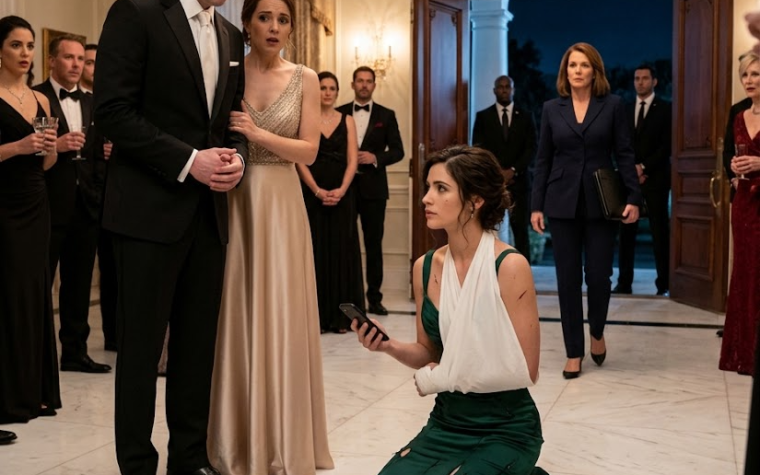
I only gave it somewhere useful to go.”
The fundraiser resumed twenty minutes later.
Margaret was removed as committee chair by an emergency vote pending an independent financial review.
Daniel was appointed interim chair.
The sponsorship remained intact under the safeguards our company had requested.
The review later found sloppy documentation, unauthorized reimbursements, and several expenses approved without required signatures.
It did not uncover another theft like the one involving Grandma’s money, but it confirmed a pattern everyone recognized: my mother treated access as ownership and questions as betrayal.
She resigned from the committee before the final report was issued.
Lauren did not receive my signature.
Her loan application was denied, and she eventually sold the house she had been trying to refinance.
Months later, she sent me a message claiming she had never understood where the twelve thousand dollars came from.
I believed she had avoided understanding.
That was not the same as innocence.
Ethan deleted his post about success making people forget where they came from.
He replaced it with a vague complaint about public shaming and toxic relatives.
I saved that too, then stopped checking his page.
My father mailed me a letter.
He wrote that he had been afraid of my mother’s anger and ashamed of his own weakness.
He did not ask me to forgive him.
For once, he did not ask me to make his feelings easier.
I read it twice and placed it in the wooden box beneath Grandma’s letter.
I did not answer immediately.
Aunt Linda called me the week after the fundraiser.
She told me more about Grandma’s final year, the conversations surrounding the money, and the silence after I left.
She apologized without defending herself.
We began speaking occasionally.
Not as though nothing had happened.
As though something had.
The community-center renovation started that spring.
Our company funded classrooms, accessibility improvements, and a small career-resource office with evening workshops for adults returning to school.
Olivia asked whether I wanted the new classroom named after our firm.
I said no.
We named it the Eleanor Room.
At the opening, I stood near the doorway while teenagers carried folding chairs inside.
No one introduced me as Margaret Parker’s troubled daughter.
No one whispered that I had finally come home.
I had not come home.
Home was the apartment in Seattle where rain tapped the windows while I reviewed reports.
Home was Rachel answering the phone and asking which part hurt.
Home was Olivia trusting what I saw.
Home was the life I had built after walking into the snow with two hundred dollars.
Brier Glenn was simply the place where the lie began—and where it finally lost its audience.
Before leaving town, I visited Grandma Eleanor’s grave.
I brought the wooden box but kept the letter inside.
I sat on the cold grass and told her I had finished my degree.
I told her I had built the kind of career she had wanted the money to help me begin.
I told her the twelve thousand dollars had mattered, but the greater theft had been the attempt to convince me that my memory was a symptom and my anger was a defect.
The wind moved through the bare branches above me.
For seven years, I had believed returning would require armor.
Instead, I arrived with proof.
When I left the cemetery, I carried the box against my chest.
It no longer felt like evidence waiting for a trial.
It felt like an inheritance restored—not the money, not the lost years, but the certainty that I had heard correctly, remembered accurately, and deserved the future my grandmother had imagined for me.
My family had let me disappear because my absence protected them.
I came back because I no longer needed their permission to be seen.