Colonel Thomas Whitaker opened the battered manila folder slowly, as if twelve years had not passed since I last saw one like it.
No one at the table spoke.
My mother’s hand remained frozen around the stem of her water glass.
Ethan leaned forward.
Cassandra stood beside her chair, staring at her father.
My own heartbeat seemed louder than the clock in the hallway.
Inside the folder were photocopies, handwritten notes, dated reports, and correspondence whose edges had yellowed with time.
I recognized my handwriting immediately.
Tiny block letters.
Blue ink.
Dates circled twice.
Mom looked from the papers to me.
“What is this?”
Colonel Whitaker did not answer her at first.
He pulled out the top page and laid it flat.
“This,” he said, “is why I know your daughter.”
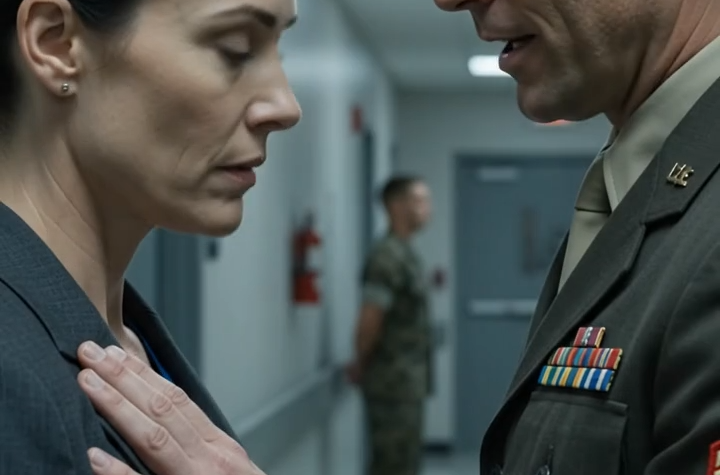
Twelve years earlier, when I was twenty-two, I had been working inside the records operation of a military hospital.
I was young enough that people spoke freely around me because they assumed I had no authority and no useful memory.
They were right about the authority.
They were wrong about the memory.
I started noticing discrepancies in civil-rights complaints passing through the hospital.
Dates changed between drafts.
Statements vanished.
Reports that had originally described retaliation or unequal treatment reappeared days later with softer language.
Concerns became misunderstandings.
Formal objections became communication problems.
And documents that should have triggered review somehow arrived at final approval looking harmless.
At first I assumed clerical mistakes.
Then I found the same pattern again.
And again.
I began keeping notes.
Not because I imagined myself heroic.
I was scared almost immediately.
I simply knew enough to understand that records were being altered after people had signed them.
Some of those records carried Colonel Whitaker’s authority.
He was responsible for the command structure surrounding the hospital.
If an investigation concluded that complaints had been suppressed under his watch, his name would be attached to every failure whether he had personally ordered it or not.
The problem was that the paperwork appeared to prove he knew.
The folder proved something very different.
I had located earlier versions of several reports, routing records showing when changes occurred, and copies of written instructions from Whitaker directing that complaints receive formal review.
Those instructions had never reached the final files in their original form.
Someone inside the administrative chain had been cleaning the record after the fact.
I documented every discrepancy I could verify.
Then I was told to stop.
I did not.
That was the beginning of the version of my life my family remembered.
The phone calls.
The lawyers.
The interviews.
The whispered warnings that I was being difficult.
The lawsuit notices that appeared later, after people whose complaints had disappeared realized there was evidence supporting what they had said all along.
My mother never asked what any of it meant.
She only saw reporters calling the house and relatives asking uncomfortable questions.
She saw my name attached to controversy and decided controversy was my personality.
Colonel Whitaker lifted another page from the folder.
“Grace brought copies of the original records forward,” he told the table.