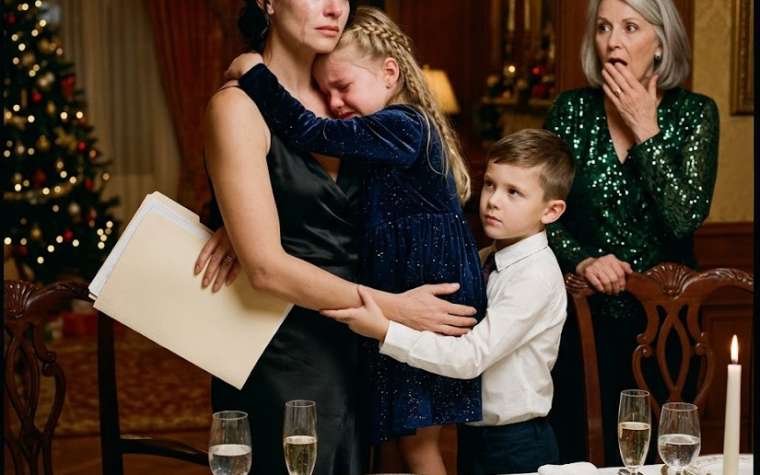
Daniel’s confidence fractured.
He left.
That afternoon, Emily gave a fuller statement.
It did not come out neatly.
Trauma rarely did.
She stopped often.
Corrected herself.
Remembered incidents out of order.
Cried when she heard herself describe behavior she had spent months explaining away.
She described Daniel gripping her hard enough to leave marks.
Shoving her against furniture during arguments.
Blocking doors.
Taking her phone.
Telling her she would lose everything if she ever made him look bad.
And she described Patricia’s role.
Patricia never struck her.
She did something more useful to Daniel.
She normalized him.
Whenever Emily protested, Patricia called her sensitive.
Whenever Daniel apologized, Patricia praised him for being patient.
Whenever Emily threatened to leave, Patricia reminded her that Daniel had money, connections, the house, and the ability to make custody difficult.
By the end of the statement, Emily looked exhausted.
But she also looked different.
For the first time, the story existed outside her body.
It had names.
Dates.
Photographs.
Messages.
Witnesses.
Daniel could still deny it.
He simply could not make it disappear by telling Emily she had imagined it.
The legal process was slower than Margaret wished and more complicated than television ever admitted.
There was no magical folder that solved everything overnight.
There were interviews, records, medical documentation, applications for protection, and careful decisions about contact and property.
Daniel hired counsel and denied abusing Emily.
He claimed the bruises came from ordinary pregnancy clumsiness.
Then he claimed Margaret had manipulated the photographs.
Then he claimed Emily had become emotionally unstable.
Each new explanation contradicted the confidence of the one before it.
His messages did even more damage.
One warned Emily that if she “forced him” to defend himself, she would regret what became public.
Another told her that no judge would believe a woman who had stayed with him for so long.
Margaret read that one twice.
She had heard variations of it throughout her career.
Abusers often mistook delayed disclosure for proof that nothing happened.
In reality, fear frequently explained the delay better than innocence did.
The strongest moment came when Emily was asked why she had remained in the house.
Daniel’s side expected confusion.
Emily answered simply.
“Because every time I thought about leaving, he reminded me what would happen if I did.”
Then she described the threats.
The baby.
The money.
The house.
The warnings that no one would believe her.
Patricia was forced to confront her own messages too.