And it couldn’t transform my parents into different people in one evening.
“I’m not leaving because I’m angry,” I told Mom.
“I’m leaving because I finally believe what you’ve all been showing me.”
Her eyes filled.
“What does that mean?”
“It means I don’t have to keep auditioning for a place in this family.”
I opened the door.
Dad called my name from behind her.
I turned once.
He looked as if he wanted to say something else.
Maybe an apology.
Maybe an explanation.
Whatever it was, he had years to find the words.
That night, I didn’t need them.
I walked down the driveway past the line of expensive cars and climbed into my fifteen-year-old car—the one Dad had mocked in front of everyone.
It started on the first turn of the key.
I laughed quietly at that.
Then I drove back to my tiny studio apartment in the part of town my mother hated.
My apartment was exactly as I’d left it: laptop on the desk, sketches pinned above my workspace, invoice reminders beside a mug of cold coffee.
Nothing impressive by my parents’ standards.
But every inch of it was mine.
Every client I’d earned was mine.
Every bill I’d paid was mine.
Every choice that had disappointed them had built a life I actually recognized as my own.
My phone began buzzing around midnight.
Apologies.
Questions.
Messages from relatives who suddenly wanted to explain why they’d stayed silent.
I didn’t answer most of them that night.
Hannah sent one message I did answer.
“Are you okay?”
I stared at it for a while.
Then I typed, “I think I will be.”
In the weeks that followed, Dad called several times.
Mom sent long messages.
I agreed eventually to speak with them, but only on terms I’d never demanded before: no insults disguised as concern, no comparisons with Madison, no discussions about my money, career, apartment, or life unless I invited them.
When Dad tried to say they had only pushed me because they wanted me to succeed, I reminded him that love without respect feels a lot like control.
For once, he listened.
Madison didn’t contact me for nearly two months.
When she finally did, her message was short.
She said she was ashamed of involving Kloe and admitted that she’d wanted everyone to see me the way she did: irresponsible, intrusive, beneath her.
She didn’t ask me to forgive her.
That was probably the first mature thing she’d done in our relationship.
I didn’t forgive her immediately either.
Some things need distance before they can become anything other than wounds.
What mattered most wasn’t that the bracelet had been found in Madison’s pocket.
It wasn’t the police arriving, or the relatives finally taking my side, or even watching my sister’s plan collapse in the room where she’d expected to humiliate me.
What mattered was the moment before all of that—when I stood alone in my parents’ bathroom with the velvet box in my hand and understood exactly what was happening.
For most of my life, I’d reacted to my family’s judgment by trying harder to prove myself.
That night, I did something different.
I stopped explaining.
I stopped begging to be believed.
I simply protected myself, stepped back into the room, and let the truth arrive on its own.
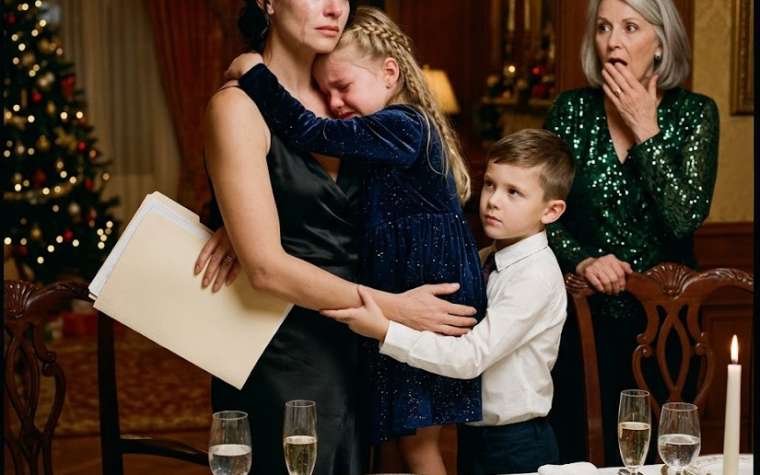
They had invited everyone except me because they wanted a family picture without the daughter who disappointed them.
By the end of the night, the picture they had worked so hard to preserve was gone anyway.
And for the first time, I wasn’t the one standing outside it wishing they’d let me in.