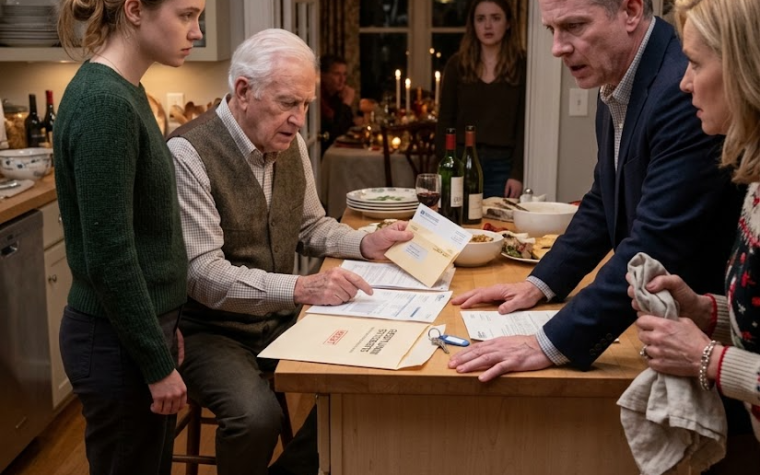
I unfolded Mom’s letter beside the legal notice and recognized the slight tilt of her handwriting immediately.
For a few seconds, I could not read it.
Not because the words were unclear, but because I remembered the hands that had written them.
Mom had always pressed too hard with a pen.
Even when her strength had started fading, every sentence left an impression on the sheet underneath.
I could sometimes feel her words before I could make myself look at them.
The legal notice from my sister’s city sat on my left.
Mom’s letter sat on my right.
Between them was the kitchen table where I had sorted medications, appointment cards, grocery receipts, utility bills, and every other ordinary piece of the life we had shared during those fourteen months.
I finally began reading.
Mom had written that she wanted the house to remain with me because it had become my home while I cared for her.
She wrote that her decision was deliberate, not impulsive, and that she understood exactly what she was doing when she arranged the papers.
Then came the sentence that made me put the letter down.
She said she knew family could turn grief into arguments about fairness, and she did not want me surrendering her decision merely to keep peace.
That was so precisely Mom that I almost heard her voice.
She had spent years watching me give ground whenever someone else became uncomfortable.
Apparently, she had worried I might do the same with the house.
I read the letter again.
Then I opened the rest of the drawer.
There were calendars filled with appointments in my handwriting.
Receipts from pharmacies, grocery stores, medical parking garages, and household repairs.
Notes Mom had dictated when she wanted something remembered.
Copies of documents relating to the house.
And several more letters, each dated and signed, written across different weeks rather than on one emotional afternoon.
None of them sounded confused.
None of them sounded pressured.
They sounded like my mother.
Practical.
Specific.
Occasionally stubborn.
One letter described why she wanted the house kept stable after her death.
Another mentioned that I had rearranged my life to move back when she could no longer manage alone.
Another made clear that loving both daughters did not require dividing every possession between them.
That distinction mattered.
My sister had spent years treating equality and fairness as if they were the same thing.
Mom had not.
I gathered the letters, the original notice, the house documents, the calendars, and the records from the months I had cared for her.
I did not call my sister.
That surprised even me.
The old version of me would have called immediately.
I would have tried to prevent escalation.
I would have explained myself before anyone had formally accused me of anything.
I would have offered compromises simply because conflict made my stomach hurt.
Instead, I responded to the legal request the same way my sister had sent it: calmly and in writing.
I provided copies of the relevant house papers and the supporting records Mom had preserved.
I included her letters because they explained what the legal language alone could not: her intention had been considered repeatedly, over time, while she was fully aware of the consequences.
Then I waited.
Four days later, my sister called.
Her name appeared on my phone while I was watering the flowers near the kitchen window.
I watched it ring twice before answering.
“Hello.”
There was a pause.
“You sent them Mom’s letters.”
“Yes.”
“You kept all of that?”
“Mom kept most of it.