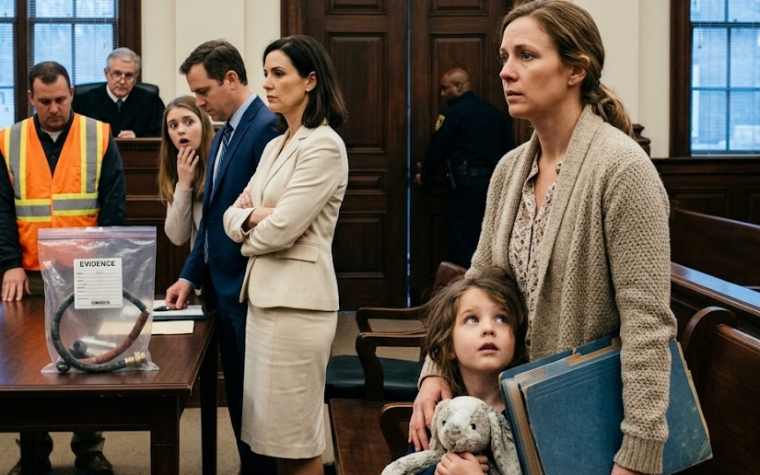
The folder made a soft sound when I opened it, barely louder than the refrigerator humming behind the prep counter.
My son-in-law stopped talking.
For the previous five minutes, he had been explaining my own business to me.
He talked about contributions.
Reliance.
Shared expectations.
The value he believed he had added during the year and a half he had worked in Clement’s old office.
He used phrases that sounded polished enough to have come directly from the attorney he had been calling in Indianapolis.
I let him finish.
Then I turned the first page toward him.
“What is this?” he asked.
“The operating agreement.”
He frowned.
“I’ve seen the operating agreement.”
“Not this one.”
That was when he finally looked at the date.
Fourteen months earlier.
His fingers stopped moving on the table.
I remembered signing that amendment in Susan’s office.
There had been no dramatic reason at the time, no $4.2 million offer, no threat, no family confrontation.
There had only been caution.
After Clement died, Susan had urged me to review every document connected to Bellflower Bakery.
For years, Clement and I had run the place with the easy understanding of two people who trusted each other completely.
But after his death, the legal structure needed to reflect the reality that remained.
I was the owner.
I was the managing member.
And if anyone was ever going to receive an ownership interest, it would require an explicit written transfer signed by me.
Employment did not create membership.
Managing invoices did not create membership.
Negotiating with vendors did not create membership.
Being married to my daughter certainly did not create membership.
The amendment said it all in language far less emotional than the circumstances now surrounding it.
My son-in-law read the relevant paragraph twice.
Then he looked up.
“This doesn’t mean what you think it means.”
It was almost impressive how quickly his confidence returned.
“Susan drafted it,” I said.
“Susan is your lawyer.”
“Yes.”
“Exactly.”
I tilted my head.
“Exactly what?”
He pushed the folder back toward me.
“You can’t just erase people’s interests because you decided to change some paperwork.”
“Whose interest did I erase?”
He opened his mouth.
Nothing came out.
That was the question he had not prepared for.
He had spent weeks thinking about how to protect an interest he assumed existed.
Apparently, nobody had asked him to identify the moment that interest had actually been created.
I had never sold him a share.
I had never gifted him a share.
I had never promised him a percentage.
His paychecks came through payroll like everyone else’s.
His job in the office gave him access to invoices and vendor accounts, not ownership.
My daughter was in the doorway by then.