“She would have.”
That sentence changed the room.
Even Wesley seemed to hear it after it left his mouth.
She would have.
Not she did.
Not she asked me to.
Not we discussed it.
She would have.
His entire plan rested on a future consent he had decided to manufacture in advance.
Cora’s face tightened.
“Wesley, you said your mom had already talked about moving.”
“I said she knew it made sense.”
“That isn’t the same thing.”
He looked from one woman to another and realized the table was no longer arranged the way he thought it was.
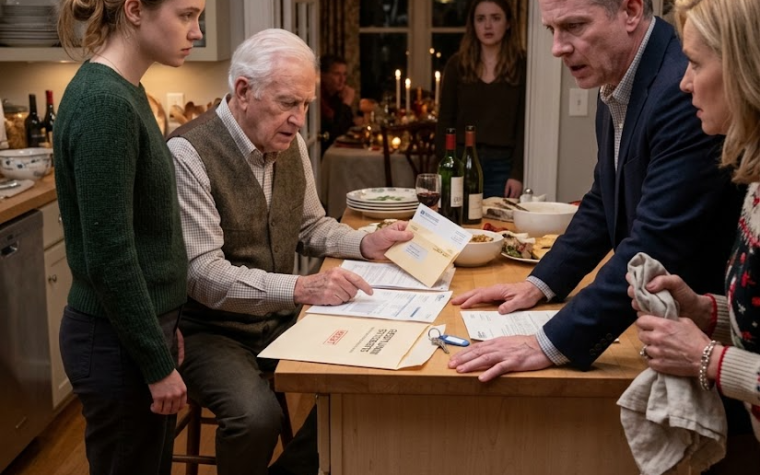
I put the documents back into the envelope.
“There’s one more thing.”
He laughed bitterly.
“Of course there is.”
“The bank has removed your access to my financial information.
The emergency authorization is gone.
My attorney now holds the backup documents.
If I ever need help, I’ll choose what help I need and when.”
His face went still.
“You don’t trust me.”
I considered that carefully.
“I trusted you with access.
You treated it like authority.”
He looked wounded, and part of me hated seeing it.
He was still my son.
That was what made betrayal inside a family so confusing.
Love did not disappear merely because trust had been damaged.
Sometimes love remained while trust had to be removed piece by piece, like glass after something broke.
Wesley pushed his chair back.
“So what happens now?”
“Tonight? You pay for dinner.”
My daughter let out a short, involuntary sound that might have been a laugh or a sob.
“And after tonight?” he asked.
“That depends on you.”
I stood.
He looked up at me.
“You’re just leaving?”
“Yes.”
“You came all this way to drop papers on the table and leave?”
“No.
I came because my bank told me where my family was.”
That landed harder than I intended.
I put the envelope into my purse.
My daughter stood too.
“Mom, can I come by tomorrow?”
Wesley frowned at her.
I answered without looking at him.
“Yes.
Alone.”
She nodded.
Cora whispered, “I’m sorry.”
I believed she was sorry about some of it.