The basement doorknob turned once, stopped, then turned again.
I kept the phone against my chest.
Marcus was still on the line, but neither of us spoke.
The door opened a few inches, spilling kitchen light down the staircase.
A broad shadow stretched across the steps.
“Anthony?” a man called.
I recognized the cadence immediately.
Not the individual voice, but the rhythm.
Thirty-five years vanished in a heartbeat.
I had spent most of my adult life making sure I never heard men like that inside my home again.
The door opened wider.
The man at the top finally saw me.
He froze.
I must have looked terrible—one leg twisted awkwardly, my wrist swelling, blood drying near my hairline—but what changed his face wasn’t concern.
It was calculation.
“Who are you?” he asked.
“This is my house,” I said.
His eyes narrowed.
“Your house?”
I almost laughed.
It hurt too much.
“My name is Vincent Caruso.”
The second man appeared behind him.
They exchanged a glance so fast most people would have missed it.
I didn’t.
Thirty-five years earlier, before Anthony was old enough to remember anything about my past, I had lived close enough to men who disguised private debts as respectable business to learn their habits.
Companies changed names whenever scrutiny got too close.
Papers became cleaner.
Offices became nicer.
But underneath the letterhead was always the same machinery: pressure, leverage, fear.
Marcus had been the man who helped me get out.
Back then, he was an investigator who knew that the easiest way to break a financial operation wasn’t through the men shouting threats.
It was through the quiet people who understood the paperwork.
I understood the paperwork.
For years afterward, I had told myself that life belonged to another Vincent Caruso.
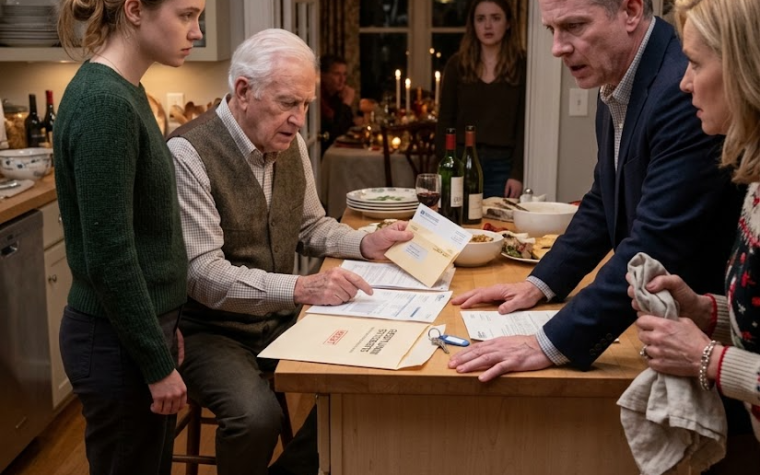
Then I found Apex Capital Solutions in Anthony’s folder.
The man on the stairs came down slowly.
“What happened to you?”
“My son pushed me.”
His expression hardened.
“Anthony did this?”
I watched him process the answer, and suddenly I understood something Anthony clearly hadn’t.
Whatever agreement he had made with Apex depended on my house being legitimate collateral.
A broken homeowner at the bottom of a locked basement was not part of that agreement.
The second man remained near the kitchen doorway.
“Where’s Anthony?” he asked.
“Out.”
“With the money?”
There it was.
Marcus heard it too.
The phone against my chest gave the faintest movement as his breathing changed on the other end.
I said, “What money?”
The first man looked at me for several seconds.
Then he reached inside his jacket and removed a folded packet.
He didn’t hand it to me.
He merely opened it far enough for me to recognize the first page.