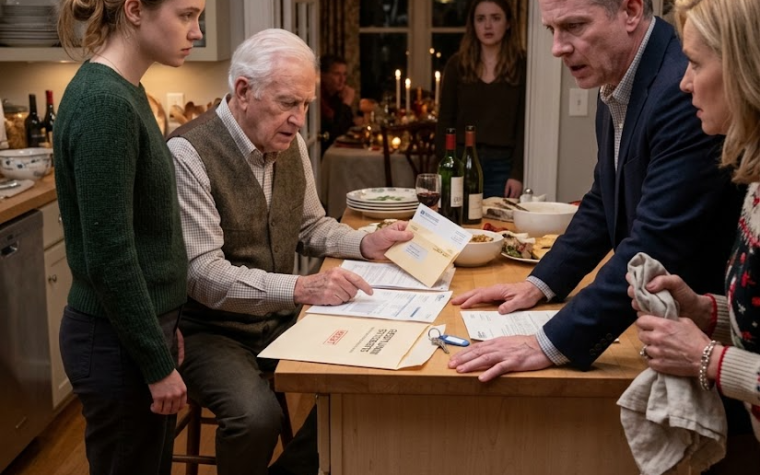
“You were paid to complete a job, not interpret paperwork.”
The kitchen went still again.
It was the kind of sentence arrogant people delivered when panic loosened their grip on caution.
The recorder captured every word.
The leader’s face hardened.
“We were paid to secure a vacant property under court authority.
Your instructions changed when we arrived.
You ordered us to assault an occupant and recover a deed.”
“I said no such thing.”
The leader pointed toward the phone clipped to his vest.
“The call was recorded by my company system.”
Arthur looked at me.
For years, he had treated silence as proof of weakness.
At family dinners, he interrupted people until they surrendered.
In boardrooms, he repeated demands until everyone mistook exhaustion for agreement.
My silence now unsettled him because it did not feel like surrender.
It felt like preparation.
I returned to Grandma’s letter.
She wrote that the farmhouse had never been a rotting liability.
Arthur had known its value for nearly two years.
Sterling Shipping planned to build an inland transfer terminal in Nelson County.
The most efficient rail and highway access route crossed the sixty acres surrounding the farmhouse.
Without an easement from the owner, the company would need to reroute the project through difficult terrain at enormous cost.
Attached to the letter was an independent appraisal valuing the land at $8.7 million before construction.
A later offer from a development consortium placed its strategic value even higher.
Arthur had offered me twenty thousand dollars.
Tyler read the appraisal over my shoulder.
“You said the corridor was already controlled,” he told his father.
Arthur’s head snapped toward him.
“Be quiet.”
That command revealed more than Tyler intended.
Mr.
Caldwell noticed it too.
“You knew about the corridor?” he asked.
Tyler swallowed.
“I knew the company needed land in that area.
I didn’t know Grandma had separated this parcel from the other holdings.”
Arthur moved toward him.
“Stop talking.”
The deputy stepped between them.
Inside the folder, beneath the appraisal, was a printed chain of emails.
Grandma had obtained them from the company account she still legally controlled as chair emerita.
The messages showed Arthur directing employees to describe the farmhouse as having negligible value in estate summaries.
Another message instructed Tyler to prepare a transfer agreement that would move the property into a shell company immediately after Grandma’s death.
The shell company was not owned by Sterling Shipping.
It was owned by Arthur.
His plan had been simple.
Acquire the land from me for almost nothing, sell the easement to the family company for millions, and present the profit as a private development success.
Grandma had discovered the arrangement.
She had responded by placing the farmhouse in trust for me.
Arthur looked from the emails to Mr.
Caldwell.
“These are privileged corporate records.”
“They are copies of communications sent through an account Margaret owned,” Caldwell said.
“She authorized their disclosure if you attempted to interfere with the transfer.”
“Attempted?” The team leader gestured toward the broken door.