Then the steps.
Then being outside with nowhere to go.
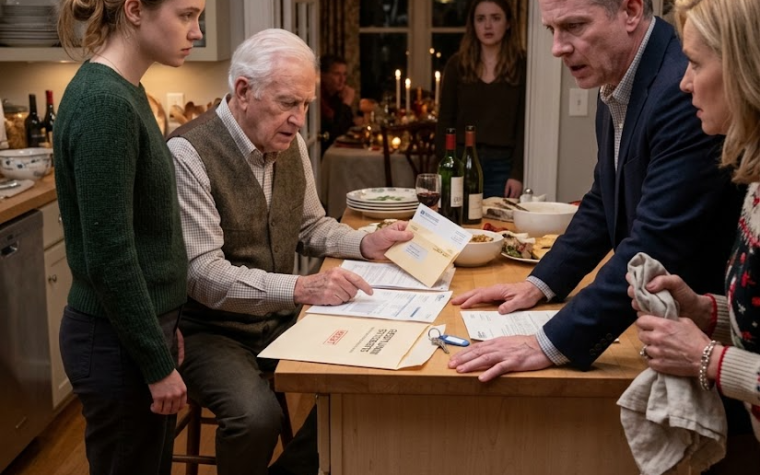
I folded Lily’s confession carefully and put it back on the table.
My father whispered, “I thought I was protecting her.”
I looked at him.
“From me?”
His face tightened.
“That’s what I believed.”
“You decided to believe it.
There’s a difference.”
He looked as if he wanted to argue.
I saw the old reflex appear—the father who had always believed volume was authority, certainty was strength, and hesitation was weakness.
Then something in him collapsed.
“Yes,” he said.
“There is.”
That answer surprised me more than an excuse would have.
My mother reached toward the envelope but stopped before touching it.
“After Lily told us, we started going back over everything,” she said.
“That night.
The days afterward.
Things you said.
Things we refused to hear.”
“Seven years late.”
“I know.”
“Do you?”
She began crying again, but I didn’t rescue her from it.
That was something the old version of me would have done.
Before the accusation, I had been the person who smoothed everything over.
If Mom was upset, I made jokes.
If Dad was angry, I found a way to redirect him.
If Lily needed something, I tried to help.
Maybe that was why being discarded had shocked me so completely.
I had confused being useful with being safe.
After they threw me out, I learned the difference.
For the first few nights, I barely slept.
I kept expecting my phone to ring with an apology.
Or at least a question.
It didn’t.
People at school had heard enough of the story to make their decision.
Baseball, the one place where I had always known exactly what was expected of me, became impossible too.
I lost the routine, the team, the future I’d been building around it.
Friends stopped answering.
Some sent short messages saying they couldn’t be involved.
Others vanished without even that.
I slept in an equipment shed when I could get away with it.
Later, I lived out of a car that coughed every time I turned the key.
I learned which parking lots stayed quiet at night.
I learned how long you could make a few dollars last.
I learned that shame followed you even when you knew you were innocent.
The worst part wasn’t hunger or cold.
It was starting to wonder whether the entire world saw something in you that you couldn’t see in yourself.
That was how I ended up on the bridge.
Rain had soaked through my clothes.
I had been awake too long.
I had lost enough that the future felt less like time and more like a threat.
I remember thinking I was tired of proving I deserved to exist.