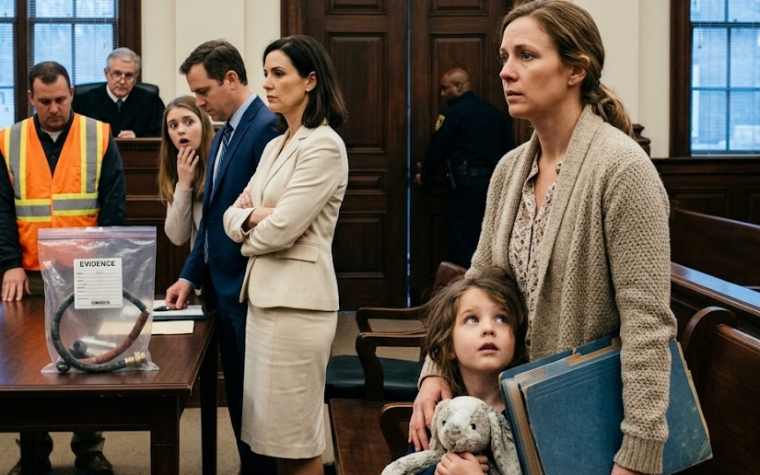
Judge Bennett studied the county clerk’s receipt for several seconds longer than Evelyn’s attorneys seemed comfortable with.
I knew exactly why.
The lead lawyer, Mr.
Pierce, shifted beside his stack of binders.
Evelyn sat at the end of the table with her chin raised, still wearing the expression she had worn in the hallway—the expression of someone waiting for the machinery of money to crush a person beneath her.
Judge Bennett looked at me.
“Mrs.
Hayes, you intend to represent yourself today?”
“Yes, Your Honor.”
Mr.
Pierce rose.
“If the court would permit me, I think it is important that Mrs.
Hayes understand this is a complicated property matter.
My client would have no objection to a brief continuance if she wishes to obtain counsel.”
It sounded generous.
It was not.
Eight days after Frank’s funeral, his firm had threatened to bury me in legal costs.
Ten minutes earlier, he had encouraged me to surrender before entering the courtroom.
Now that a judge was watching, he wanted to appear concerned for my welfare.
“I appreciate counsel’s concern,” I said, “but I’m prepared to proceed.”
Pierce turned slightly toward me.
There was the smile again.
“Of course.”
Judge Bennett glanced at the folder in front of me.
“Very well.”
The hearing concerned Evelyn’s request to invalidate the deed transferring the Smith Mountain Lake property from Frank to me.
Her complaint claimed Frank had lacked capacity and that I had exercised undue influence during his illness.
Pierce began exactly where I expected him to begin.
He described Frank’s cancer.
He described the chemotherapy.
He described the physical weakness of his final months.
Then he described me.
Not as Frank’s wife of twenty years.
Not as the person who attended his appointments and managed his medications.
I became, in Pierce’s telling, an opportunistic spouse who had isolated a dying man and persuaded him to give away an asset his mother believed should eventually return to the Carter family.
Evelyn watched the judge while Pierce spoke.
Every few moments, she gave a tiny sorrowful nod.
She was performing grief now.
I had seen Evelyn genuinely grieve at Frank’s funeral.
I knew the difference.
Pierce held up a copy of the recorded deed.
“This document was executed while Mr.
Carter was receiving serious medical treatment.
Mrs.
Carter believes her son was vulnerable, impaired, and incapable of understanding the long-term consequences.”
Judge Bennett asked, “Do you have evidence that he was legally incapacitated at execution?”
Pierce paused.
“We intend to establish the totality of circumstances.”
That was lawyer language for not yet.
I wrote one word on my legal pad.
Capacity.
Pierce called Evelyn.
She walked to the witness chair with a handkerchief folded in one hand.
Under his questions, she described Frank as confused, exhausted, and dependent.
She said he had always loved the lake house.
She said it had been in the Carter family and that she could not believe he would voluntarily give it to me outright.