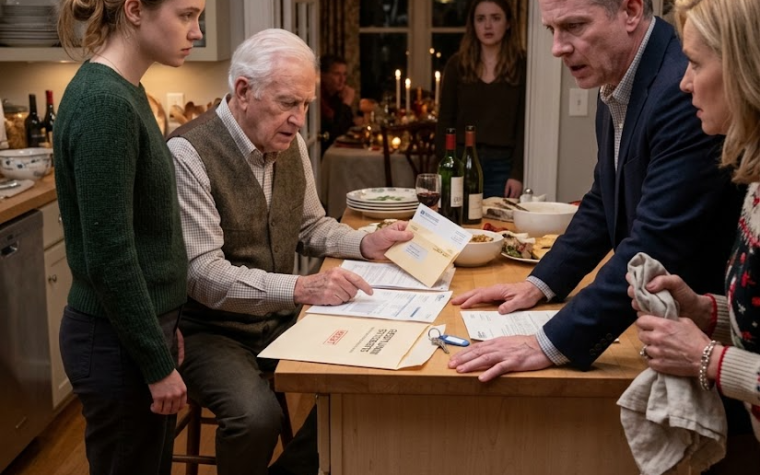
“No.”
“Necessary support for either child?”
“Mom, everything doesn’t fit into one of your categories.”
“Those are not my categories.
They’re the trust’s categories.”
His frustration sharpened.
“This is why Amber says talking to you is impossible.”
I closed my eyes.
There was a time that sentence would have sent me scrambling to prove I was reasonable.
Instead I said, “If you need help with a legitimate expense for the children, send it to me.
I will consider it exactly the way I always have.
I will not transfer the trusts.”
“So that’s it?”
“On that question, yes.”
He hung up angry.
For the next two weeks, the family entered a cold little war nobody formally declared.
Amber stopped sending pictures of the children.
She removed me from a group message about school activities, then added me back after Derek apparently objected.
Invitations that had once arrived casually became stiff and last-minute.
I knew what was happening.
Access to Lucas and Sophie had become leverage.
That hurt.
But it also clarified something I had spent years refusing to see.
Money had become entangled with belonging.
As long as I paid quietly, I was helpful.
The moment I protected a boundary, I was interfering.
So I changed one more thing.
I stopped the extras.
Not the trusts.
Those remained untouched and fully protected for the grandchildren.
Not birthdays or ordinary grandmother gifts.
But the endless rescue checks ended.
When Derek mentioned a car repair, I sympathized and did not reach for my checkbook.
When Amber complained that preschool costs had gone up, I reminded her that Sophie already had a qualified educational expense process available through the trust if the school met the requirements.
She did not submit anything.
When Derek hinted that their refrigerator was making noise, I gave him the name of the repair company I used.
For the first time in seven years, their problems remained theirs long enough for them to feel the actual size of them.
A month after the birthday party, Derek asked to come over alone.
He sat at my kitchen table where Martin used to read the newspaper.
He looked exhausted.
“Amber thinks you’re punishing us.”
“Are you here to talk about what Amber thinks, or what you think?”
He stared at the wood grain.
“I handled the birthday badly.”
It was not much, but it was the first honest sentence he had given me since the party.
“Yes,” I said.
He winced.
I did not soften it.
“You heard her tell me I was interfering.
You heard her demand the trusts.
You stood there.”
“I didn’t want a fight at Lucas’s birthday.”
“Then you could have said, ‘Not here.’ You could have said, ‘We’ll discuss this later.’ You could have said anything that told your mother she was not alone in that hallway.”
Derek rubbed both hands over his face.
“I know.”
I let the silence sit.