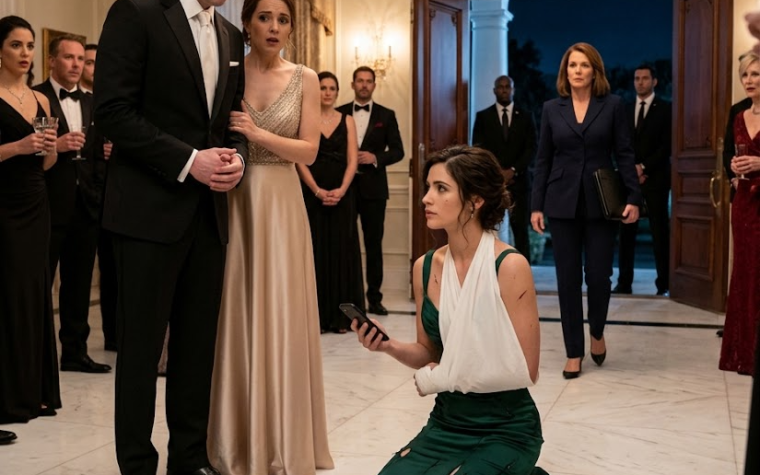
“There will be no wedding tonight.”
Rachel turned toward him.
“Alexander, please.
The entire world is waiting.”
“That is exactly why I cannot continue.
Marriage requires trust when no one is watching.
You lied while everyone was watching and expected the spectacle to protect you.”
She reached for him, but he stepped back.
For the first time that day, the cameras, guests, flowers, and palace walls could not give Rachel control.
The royal household announced that the ceremony had been postponed by mutual decision.
No accusation was made publicly that night.
The king refused to turn a private betrayal into entertainment.
But he also refused to bury it.
Rachel was removed from all planned duties with the royal charitable foundation.
Her access to official wedding offices was suspended, and the falsified document was referred for formal review.
Because no financial gain or security breach had resulted, the matter remained internal, but the consequences were real.
Prince Alexander ended the engagement several weeks later.
He did so privately.
His public statement contained no insult, only the sentence: “A life of service cannot be built on a foundation of deliberate deception.”
Rachel returned to the United States without a title.
For months, she blamed everyone else—the palace staff, the recorded call, the pressure, the press, our parents, and especially me.
I did not argue with her.
I returned to Norfolk and resumed my duties.
The royal guards disappeared from our street.
The neighbors stopped watching my house.
The news cycle moved on to another scandal.
But something inside our family had changed.
The old arrangement was over.
Rachel could no longer wound us and depend on our silence to preserve her image.
Nearly a year later, a plain envelope arrived at my townhouse.
There was no crest, no expensive stationery, and no carefully staged photograph.
Inside was a handwritten letter from Rachel.
She did not ask me to forgive her.
She did not blame the palace.
She did not say she had only wanted one perfect day.
She wrote that she had spent her life believing admiration was scarce.
When I earned respect, she felt diminished.
When our parents praised my service, she heard criticism of herself.
Instead of confronting that fear, she tried to remove the person who triggered it.
“I did not erase you because you were embarrassing,” she wrote.
“I erased you because I was ashamed of who I became beside you.”
It was the first completely honest thing she had said to me in years.
I did not call her immediately.
Forgiveness is not the same as pretending damage never happened.
Trust does not return because someone finally describes how they broke it.
But I placed the letter in a drawer instead of throwing it away.
A week later, I sent one message.
“I received your letter.”
That was all.
It was not reconciliation.
It was a door left unlocked.
The king later sent me the original invitation that had been approved before Rachel intercepted it.
A brief handwritten note accompanied it.
“Service requires no apology, and dignity requires no permission.”
I framed the invitation beside my Navy commendations—not because it came from a king, and not because I regretted missing a royal wedding.
I framed it because my name was printed clearly across the front.