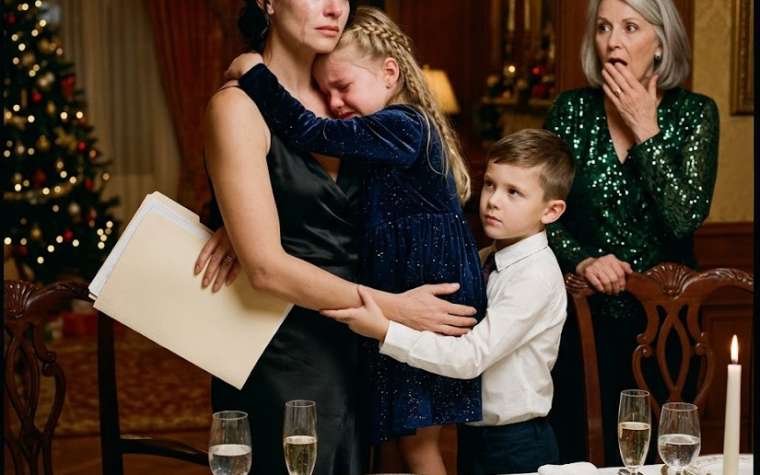
He listened when I told him I no longer trusted his judgment around his family.
He changed the locks on the apartment before I was discharged, removed Paola from every shared account and access list, and gave building security a copy of the protective order.
More importantly, when relatives called to say Paola had made a terrible mistake and needed family support, Alejandro stopped them before they could ask me to be merciful.
“She needs accountability,” he told them.
“My wife and daughter need safety.”
His parents visited the hospital only when I agreed.
His mother apologized more than once, but the apology that mattered came without an excuse.
“I saw danger,” she said, “and I hesitated because confronting Paola was uncomfortable.
You paid for my hesitation.”
I did not tell her it was fine.
It was not fine.
But I believed she finally understood.
Months later, Paola accepted a plea agreement that included probation, mandatory counseling, community service, and a continued no-contact order.
The medical records, witness statements, and her own changing explanations left little room for the harmless-prank story she wanted everyone to believe.
She sent an apology through her lawyer.
It said she had never intended to hurt the baby.
I read that sentence twice.
Then I handed the letter back to my attorney.
The apology focused on her intention, not her choice.
She had intended to frighten me.
She had intended to humiliate me.
She had intended to make a pregnant woman beg through a locked glass door while she watched.
The fact that she had not intended the worst possible outcome did not make her actions innocent.
Our daughter eventually came home with a heart monitor, a stack of medical instructions, and an appointment calendar that covered half the refrigerator.
She was still tiny, but she was alert and stubborn.
When she disliked something, she made sure the entire apartment knew.
On her first night home, I sat beside her crib until dawn.
Alejandro found me there with one hand resting near her chest, counting every breath.
He did not tell me to relax.
He brought a chair and sat beside me.
We stayed there together in the dark.
The following winter, we moved to another apartment.
It had no balcony.
On the day we unpacked, I found the old plastic serving tray at the bottom of a kitchen box.
One corner was cracked from where I had struck it against the glass.
For a moment, I was back in the cold, watching people move through a warm room while my body failed beneath me.
Then my daughter cried from the bedroom.
I carried the tray to the trash and went to her.
She was lying in her crib, kicking both legs with surprising strength.
When I lifted her, she pressed one warm hand against my neck.
The doctors had warned us that prematurity could leave questions for years.
We still attended appointments.
We still watched closely.
We still carried fear into rooms where other parents seemed able to breathe easily.
But she was there.
So was I.
Paola had wanted me to feel weak, helpless, and dependent on whether someone chose to open a door.
Instead, the truth forced every person in that family to see what their silence had protected.
Alejandro could no longer dismiss cruelty as personality.
His parents could no longer confuse peace with avoiding confrontation.
And I no longer accepted belonging that required me to endure humiliation quietly.
That night on the balcony changed our family forever.
Not because suffering made me stronger.
Because when the door finally opened, so did everyone’s eyes.