My husband looked around the gym.
“I did not come here to frighten anyone.
I came because an officer told me my daughter had a dance tonight.
I was given the choice to wait at the base while they completed more interviews or come home under escort.”
He glanced at Emma.
“I had already lost two years.
I was not giving up another hour.”
I finally found enough breath to ask the question that had been tearing through me.
“How?”
He turned toward me.
The answer did not come easily.
“During the convoy attack, the first blast overturned our vehicle,” he said.
“I was thrown down an embankment.
My identification pouch and part of my vest were torn away.
The recovery team found damaged remains near my equipment.”
He paused when Emma tightened her grip on him.
“They believed those remains were mine.
The initial identification was made from the gear and tags because the condition of the vehicle made visual identification impossible.”
The coffin had remained closed for that reason.
I remembered being told that seeing him would only deepen the trauma.
I had believed the officials were protecting me.
“What happened to you?” I asked.
“A local medic found me unconscious miles from the wreckage.
I had a head injury and could not tell him much.
Before he could move me to a safe area, an armed group took both of us.”
He did not describe what followed.
He did not need to.
The hollows beneath his eyes and the way he watched every doorway told enough.
“They moved us repeatedly,” he continued.
“I stopped using my name because they were questioning people about the unit.
Months became longer than I could measure.
Three weeks ago, during another transfer, a patrol intercepted the vehicle.”
“Three weeks?” I whispered.
“They did not know whether I was who I claimed to be.
I had no identification, and officially I had been dead for two years.
They ran fingerprints, medical records and DNA.
Until the results came back, they kept the recovery confidential.”
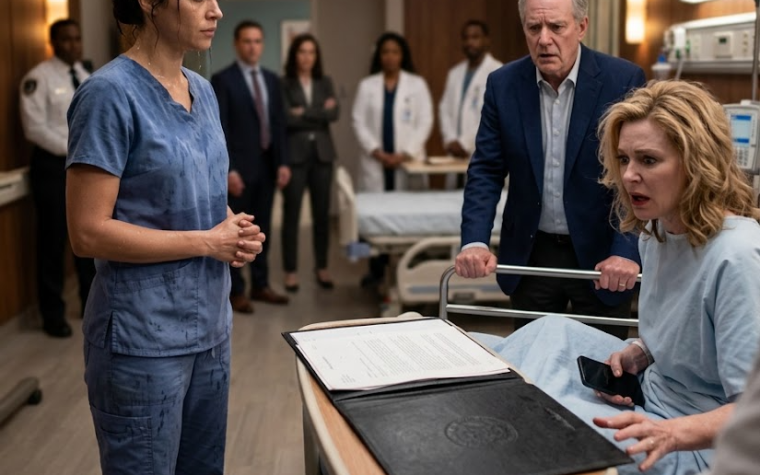
He tapped the open folder.
“The final DNA confirmation arrived this morning.”
I looked at the official page again.
The document was dated that day.
The officer who had once notified me of my husband’s death had been assigned to tell me he was alive.
He had called our house, my cell and the school office.
My phone had been silenced because the invitation requested that parents avoid interruptions during the dance.
The principal checked his own phone and went pale.
“There are messages from the district office,” he admitted.
My husband gave a tired nod.
“The driver brought me directly from the airfield.”
Melissa folded her arms.
“This has nothing to do with me,” she said.
“I could not possibly have known he was alive.”
“No,” my husband replied.
“You could not.”
For a heartbeat, relief flickered across her face.
Then he continued.
“You believed I was dead when you attacked her.