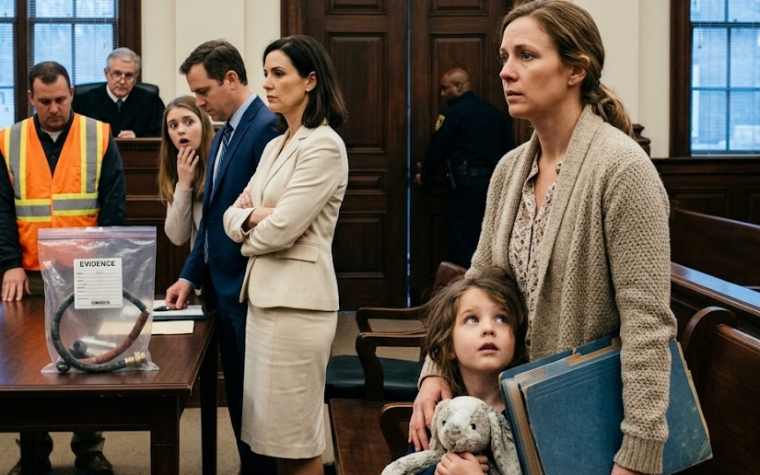
He accused Ethan of stealing private property and called the entire situation a family conspiracy designed to destroy him.
Then security officers found the bottle.
It had been pushed behind a cleaning unit near the service elevator.
Adrian’s fingerprints were on the cap.
Residue inside matched the substance in William’s coffee.
A second search uncovered Rebecca’s old phone in Adrian’s jacket and a forged catering credential containing his photograph.
The surveillance timeline showed him entering the executive lounge, checking the corridor, and tilting the bottle over William’s cup.
The evidence did not depend on Ethan’s word anymore.
But William understood that none of it would have been found in time without him.
Police entered Harrison Tower shortly before noon.
As Adrian was led from the conference room, he stopped near Ethan.
“You think he wants you?” he said.
“He didn’t even want your mother.”
Ethan flinched.
William stepped forward, but Ethan raised one hand.
For the first time that morning, the boy’s voice did not tremble.
“She came here with the truth.
You stopped her.”
Adrian’s face hardened.
Ethan continued.
“I came here with the truth too.
You couldn’t stop me.”
The officers escorted Adrian away.
The board meeting was postponed.
William ordered the trust transfer frozen and requested an emergency independent review of every vendor account Rebecca had identified.
Within days, investigators uncovered years of fraudulent payments tied to Adrian and two shell companies.
Several employees were interviewed, but no evidence showed that Harrison Group executives had participated in the poisoning plan.
The company’s failure was different and, to William, nearly as serious.
Rebecca had raised concerns years earlier.
Her warnings had been routed through internal channels, minimized as a personal dispute, and quietly closed after William dismissed her credibility.
The system had done exactly what powerful systems often did when the truth arrived in an inconvenient voice.
It protected itself.
Adrian was charged with attempted murder, fraud, identity theft, and evidence tampering.
His attorneys argued that the substance had been intended only to make William ill, but laboratory analysis and the amount placed in the cup contradicted them.
He was denied access to Ethan while the criminal case proceeded.
Family court did not simply hand Ethan to William because they shared blood.
Social workers interviewed them separately.
William’s home was evaluated.
Rebecca’s recordings were reviewed, along with Adrian’s history and Ethan’s wishes.
For several weeks, Ethan stayed with a licensed temporary caregiver while William visited every afternoon.
At first, their conversations were awkward.
William knew how to negotiate acquisitions and calm angry shareholders.
He did not know what a ten-year-old liked to eat or why Ethan carried three sharpened pencils even when he had no homework.
Ethan knew how to read danger in a hallway.
He did not know whether a billionaire grandfather who had ignored his mother could be trusted after one dramatic morning.
So they began with small truths.
William admitted he had received two messages from Rebecca years earlier and deleted them without listening.
Ethan admitted he had almost left the tower when he saw security at the elevators.
William confessed that he had spent eleven years pretending anger was the same thing as certainty.
Ethan confessed that he still missed Adrian sometimes, even after what he had done.
William did not tell him that feeling was wrong.
That answer mattered.
A judge eventually approved a temporary kinship placement with William under court supervision.
Ethan moved into the quiet house overlooking Lake Washington with his old backpack, four books, the cracked phone, and the photograph Rebecca had left behind.
The eight-percent trust remained Ethan’s property.
William placed its voting authority under an independent fiduciary until Ethan was old enough to understand and exercise it himself.