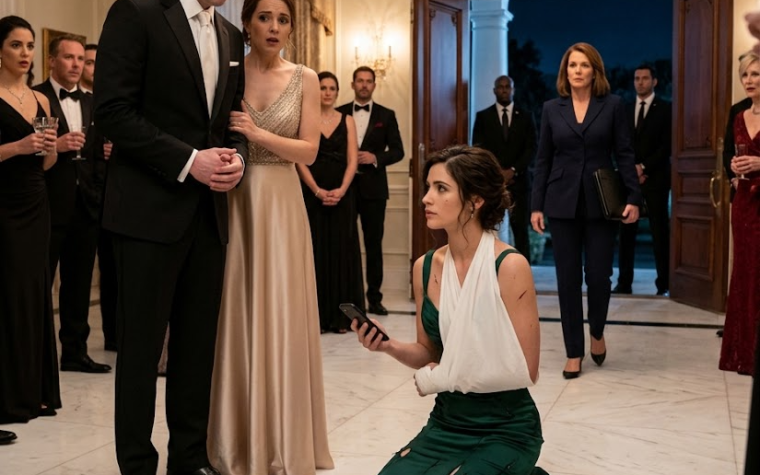
Staff moved quietly among abandoned glasses and folded napkins.
He stood several feet away from me, uncertain whether he had the right to come closer.
“Why didn’t you tell me?” he asked.
I almost laughed.
“That I built a company?”
“That you were… all of this.” He gestured helplessly toward the ballroom.
“You never asked who I became.”
He lowered his hand.
“You only remembered the girl you sent away,” I said.
“And even then, you remembered Bianca’s version of her.”
He began to apologize.
Not elegantly.
Not in a way that erased anything.
He admitted he had chosen the easiest explanation because questioning Diane and Bianca would have threatened the new life he wanted.
He admitted that after I left, pride kept him from searching.
Every year made the silence harder to break, so he told himself I preferred it.
I listened.
Then I told him I was not ready to forgive him.
He nodded as though the answer hurt, but he did not argue.
“That is fair,” he said.
It was not enough.
But it was the first time he had allowed my judgment to stand without trying to replace it with his own.
Julian found me near the ballroom doors.
He had changed nothing about the business agreement, and I made it clear that I would not use a personal disaster to punish employees or alter contracts.
The Mercer group would continue operating under the same terms.
He thanked me, then apologized for believing Bianca’s warnings before speaking to me himself.
“You recognized me at the bar,” I said.
“I did.”
“Why didn’t you come over?”
“She told me you might create a scene.”
I glanced back at the abandoned wedding.
“She was right about the scene.”
For the first time that evening, he almost smiled.
Three weeks later, Julian formally ended the engagement.
The preserved security footage and witness statements prevented Bianca from recasting the incident as a misunderstanding.
She issued no public apology.
Through a lawyer, she claimed emotional distress.
I chose not to pursue criminal charges, but I did obtain a protective order after she sent a series of threatening messages.
Diane moved out of my father’s house before the end of the month.
She later sent me a written statement describing what she had witnessed on the night of the ruined dress.
I placed it with the wedding footage in a locked file—not because I wanted to relive either event, but because I was finished allowing other people’s confidence to outweigh the truth.
My father began writing letters.
I did not answer the first two.
I opened the third.
There was no request for forgiveness inside, only an account of the years he had avoided examining and the harm his cowardice had caused.
At the bottom, he wrote that he would continue taking responsibility whether or not I ever allowed him back into my life.
I kept the letter.
Months later, I returned to the Mercer Grand for a board meeting.
The ballroom had been reset for a charity dinner.
New glasses stood beneath the chandeliers, and the floor shone as though nothing painful had ever happened there.
The ballroom manager asked whether I wanted the champagne tower removed.
I looked at it for a moment.
“No,” I said.
“Leave it.”
Glass had not humiliated me.
A room had not rejected me.