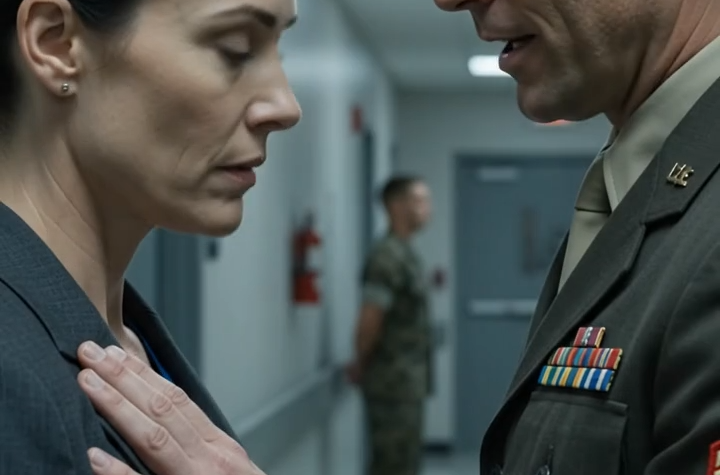
“Cook,” General Sterling said quietly, “where did you get that mark?”
Saul looked down at his own forearm as though the faded insignia belonged to somebody he had not thought about in a very long time.
For several seconds, nobody moved.
The range had been noisy only moments earlier—bolts cycling, men arguing, the hot wind pushing against canvas and equipment.
Now even Captain Miller seemed afraid to make a sound.
Saul finally raised his eyes.
“I earned it.”
Miller recovered first.
His embarrassment immediately hardened into anger.
“Earned it where? A surplus store?”
Saul gave him no answer.
General Sterling did not laugh.
He had seen that insignia before, but never on a living man standing three feet away from him.
Years earlier, buried inside sealed operational records, he had studied references to a sniper section whose deployments had been removed from ordinary military history.
The unit had no public honors, no photographs hanging in hallways, and no stories told during ceremonies.
Its missions existed in fragments, blacked-out reports, and memories carried by the few people who had survived them.
Officially, it had disappeared.
The faded symbol on Saul’s arm had belonged to that unit.
Sterling’s gaze shifted from the insignia to Saul’s face.
The stooped shoulders suddenly looked different.
So did the careful way the old man positioned his feet.
So did the habit of watching the canyon instead of the equipment.
“How long?” Sterling asked.
Saul understood the question.
“Long enough.”
Miller shook his head.
“Sir, with respect, we have three qualified shooters on this line.
Whatever the cook did fifty years ago does not make him current on a classified system.”
Saul turned toward him.
“You’re right.”
The answer seemed to surprise Miller more than an argument would have.
Saul nodded toward the rifle.
“I don’t know your paperwork.
I don’t know what somebody named the platform.
And I haven’t fired that model.
But the bullet still has to cross the same air your men keep pretending is uniform.”
He pointed toward the distant cut in the canyon.
“That part hasn’t changed.”
Sterling studied him for another moment, then stepped aside.
“Let him shoot.”
Miller’s jaw tightened.
“General—”
“That was an order.”
Saul did not smile.
He did not look at the younger soldiers who had laughed at him.
He simply removed his dusty shoes from the edge of the mat, lowered himself carefully onto his stomach, and settled behind the rifle.
His age showed in the time it took him to get down.
It disappeared once his shoulder met the stock.
The transformation was almost uncomfortable to watch.
His back settled.
His elbows found the earth without searching.
His cheek rested against the stock with the familiarity of someone placing his head on an old pillow.
He did not grip the weapon like a man trying to dominate it.
He seemed to become still around it.
Miller watched from above with his arms folded.
“At least use the current firing solution.”