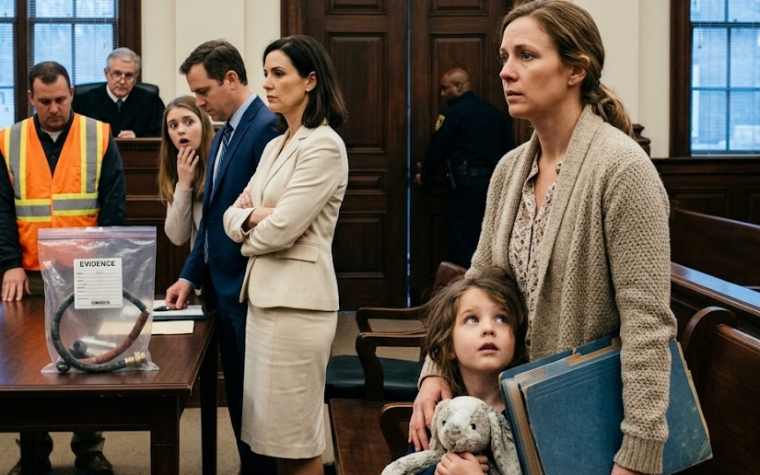
“This is humiliating.”
The words stunned me.
She was not apologizing for humiliating me.
She was angry that the truth had interrupted her performance.
Daniel looked toward the wedding photographs displayed on a projection screen.
In every image, Sloan stood beneath white roses surrounded by lavender dresses.
I had been moved out of the frame.
He looked back at my orange dress.
“Was the dress deliberate?” he asked.
No one answered.
He turned to the bridesmaids.
One of them, a woman named Marissa, began twisting the stem of her champagne glass.
“Sloan said Emma requested orange,” she admitted.
“I did not,” I said.
Another bridesmaid spoke without looking at Sloan.
“There were two extra lavender gowns.
Sloan told the coordinator not to let Emma have either one.”
My mother stepped between them.
“Enough.
This is becoming cruel.”
I looked at her.
“Cruel to whom?”
She opened her mouth, but no answer came.
The service doors at the rear of the ballroom opened.
An elderly woman entered carrying a sealed envelope and a thick blue ledger.
I recognized her immediately.
Helen Pierce had been Grandma Ruth’s attorney for nearly twenty years.
She had helped me arrange medical authorization when Grandma could no longer manage her own appointments.
She had sat at our kitchen table while Grandma, still mentally sharp, signed documents with a trembling hand.
Sloan whispered, “She was never supposed to be invited.”
Margaret heard her.
“That is an interesting choice of words.”
Helen walked to our table and placed the blue ledger in front of me.
“Ruth asked me to keep this,” she said.
“She believed it might become necessary.”
The cover was worn at the corners.
Inside were Grandma’s handwritten notes from the final eighteen months of her life.
Her handwriting weakened over time, but it remained recognizable.
She had recorded visits, expenses, and conversations because, as she once told me, memory became a battlefield when selfish people wanted to rewrite it.
Helen opened to a marked page.
Grandma had written that I arrived before sunrise after a fourteen-hour trip and slept on the floor beside her hospital bed.
Another entry described Sloan calling to ask whether Grandma could lend her money for a resort weekend.
Sloan did not ask about her recovery.
A later page recorded my mother urging Grandma to tell relatives that Sloan was helping with her care because “the family needed Sloan to look responsible.”
Mom’s face tightened.
“That woman was heavily medicated.”
Helen remained composed.
“Ruth’s physician evaluated her capacity before each legal meeting.
She was competent.”
She placed the sealed envelope beside the ledger.
“This is a copy of Ruth’s final affidavit.
The original is filed with the county clerk.”
Daniel read the first paragraph silently.
His face changed as he continued.
Grandma had documented that I was her primary caregiver and had paid expenses the family promised to reimburse but never did.
She had also described pressure from my mother and Sloan to alter her estate plan.