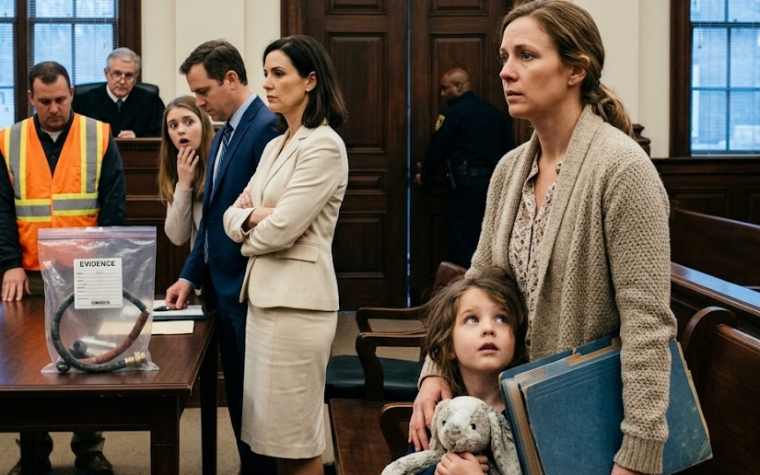
The clubhouse doors opened just as the HOA’s lawyer finished reading the second page of my deed.
Two members of the property management staff entered carrying a box of association records.
Behind them came Brad from Summit Tree & Land Management, still wearing the same company jacket shown on the business card Mara had found beneath my windshield wiper.
The HOA president’s smile disappeared.
She had invited me to that meeting expecting an apology, a warning, or perhaps an angry speech she could dismiss in front of her neighbors.
She had arranged the chairs so the homeowners faced me like a jury.
She had placed her lawyer at her right hand and a printed copy of the association rules in front of her.
What she had not expected was her own contractor walking through the door.
“What is he doing here?” she asked.
Brad stopped beside the table.
He looked uncomfortable, but not uncertain.
“I was asked to provide the work-order file,” he said.
“By whom?”
“By the owner of the property where my crew cut the trees.”
Every face in the room turned toward me.
I kept one hand on the brown folder my father had stored for years.
The paper was soft at the folds and smelled faintly of dust.
When I was a child, I had seen him open that folder at the kitchen table whenever taxes were due or a boundary question came up.
Back then, it had seemed like one more boring collection of adult documents.
Now it was the most powerful object in the room.
The lawyer tapped the survey with one finger.
“This road segment,” he said slowly, “crosses Mr.
Hale’s parcel before reaching association property.”
The president gave an irritated laugh.
“We know that.
The neighborhood has used it for years.”
“Use does not necessarily establish ownership.”
“We have access rights.”
The lawyer studied the deed again.
“I don’t see a recorded easement attached to this instrument.”
A murmur moved through the chairs.
The president’s shoulders stiffened.
“There must be one somewhere else.”
“That is possible,” he said, though his tone suggested it was becoming less possible by the second.
I pulled out another page.
“I checked the county records yesterday,” I said.
“There is no permanent access easement recorded for Cedar Ridge Estates across my parcel.”
The room became still.
One of the homeowners near the back raised his voice.
“Then how was the development approved?”
The president turned sharply.
“This meeting is about the trees.”
“No,” I said.
“This meeting is about what happens when you treat another person’s property as if it belongs to you.”
She looked at the lawyer.
“Tell him he can’t block the road.”
The lawyer did not answer immediately.
I understood why.
Closing a road used by dozens of families was not something I could do recklessly.
I had no interest in trapping anyone, preventing emergency access, or creating a dangerous situation.
Before coming to the meeting, I had already spoken with counsel, reviewed the survey, checked the county index, and contacted the local fire department about emergency arrangements.
But the HOA president did not know any of that yet.
She only knew the confidence had drained from the man sitting beside her.
Brad opened the file he had brought.
“My company was given a signed authorization stating the association controlled the tree line,” he said.
“We were also supplied with a marked photograph showing the removal area.”