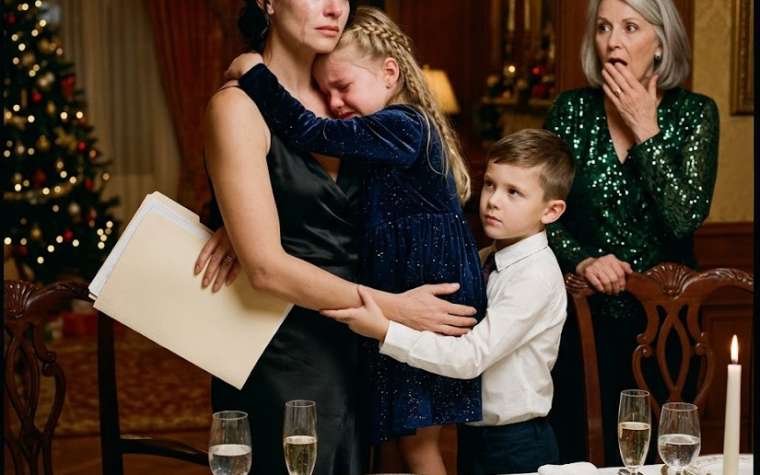
Sarah argued that having children meant the Tahoe was naturally more useful to her.
Every argument had the same structure.
They explained why they deserved more.
Neither explained why I deserved nothing.
That difference became impossible to ignore.
Dad’s written instructions controlled the estate distribution to the extent the law allowed, and the assets that belonged to the estate were handled accordingly rather than according to the living-room ceremony my mother had staged.
My documented funeral expenses were reimbursed before the remaining distributable estate was divided.
The house was not simply Michael’s because Mom had handed him a deed.
The Tahoe was not simply Sarah’s because she wanted more space.
The savings were accounted for.
Grandma’s bracelets were treated as part of the property that needed to be handled correctly instead of as a prize Sarah could wear home that afternoon.
When everything was finally settled, the outcome was far less dramatic than my siblings had expected and far more fair than they wanted.
Nobody walked away with everything.
Nobody was erased.
The estate was handled under Dad’s actual instructions, with each of us receiving the share we were legally entitled to after expenses and proper accounting.
And I kept the wardrobe.
Michael never repaid the old apartment money he owed me.
The will did not magically repair eight years of resentment.
Sarah never admitted that laughing at my inheritance had been cruel.
Mom never gave me the apology I sometimes imagined hearing late at night.
Real families rarely transform because one document appears.
What changed was simpler.
I stopped cooperating with the version of our family in which fairness meant I surrendered first.
A few months later, I repaired the wardrobe.
I replaced the broken leg instead of balancing it on the old landscaping brick.
I sanded the roughest edges but left much of the peeling cherry-red paint untouched.
I wanted it to look like Dad’s.
Inside, I hung one of his old flannel shirts.
In the bottom drawer, I kept the small notebook containing the funeral expenses.
Behind it, I placed his letter.
I read that letter only occasionally.
The sentence I returned to most was not about money or property.
It was near the end.
Dad wrote that he was sorry he had allowed peace in the family to depend so often on the person least likely to complain.
He said quiet children are easy to overlook because they learn to carry disappointment without making the room uncomfortable.
Then he wrote that quiet did not mean weak.
For seventy-three nights, I had sat outside his hospital room listening to him breathe.
For forty days after his burial, I had carried grief alongside funeral bills, family expectations, and the familiar knowledge that when something had to be sacrificed, everyone would eventually look toward me.
On the day they divided his belongings, I nearly accepted that role again.
A house for Michael.
A Tahoe, savings, and gold for Sarah.
A broken wardrobe for me.
The strange thing was that I still would have taken the wardrobe even if there had been nothing hidden inside.
It smelled faintly of cedar and machine oil.
Its drawers stuck in humid weather.
There were scratches near the handles from Dad’s wedding ring brushing the wood over decades.
It contained pieces of him nobody else valued.
That had been enough for me.
The papers behind the drawer simply forced everyone else to confront what they had been willing to do when they believed there would be no consequence.
Years of family habits had been exposed in less than an afternoon.
Michael believed responsibility made him entitled to the house, even though he had not sat beside Dad once in seventy-three hospital nights.
Sarah believed motherhood made her needs automatically larger than mine.
Mom believed keeping peace meant giving the loudest children what they wanted and asking the quietest one to understand.
And I had spent years helping that system survive by swallowing the cost.
Dad’s final gift was not making me richer than them.
He did not secretly disinherit everyone else.