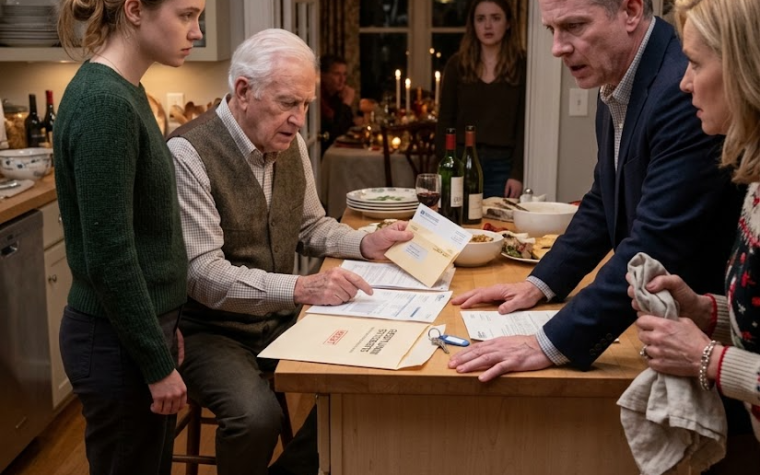
Sebastian recognized the folded document before Valerie did.
His eyes dropped to it, then came back to me.
“Mom,” he said quietly.
“Don’t do this here.”
I almost laughed.
Not because anything was funny, but because of the absurdity of the request.
They had chosen the restaurant.
They had chosen the audience.
They had chosen to invite me two and a half hours late, leave me without food, push a $3,400 bill toward me, and turn my confusion into entertainment for nine people.
But now Sebastian wanted privacy.
I rested my hand on the wine-colored notebook.
“You didn’t seem worried about doing things here five minutes ago.”
Valerie leaned forward.
“What is that paper?”
I unfolded it.
It wasn’t mysterious.
It wasn’t dramatic.
It was something much more dangerous to people who depend on everyone else forgetting what they promised.
It was a written repayment agreement Sebastian had signed after one of the many times he had come to me for financial help.
Over three years, there had always been a reason.
Something temporary.
Something urgent.
Something that would supposedly be corrected next month.
I had heard the same phrases in slightly different forms until I could predict them before he finished speaking.
“I just need a little help until things settle down.”
“I’ll pay you back after the next deposit.”
“Valerie doesn’t know I’m asking.”
“Please don’t make this a big deal, Mom.”
At first, I hadn’t made it a big deal.
I was his mother.
I remembered the thirteen-year-old boy who had stood beside Arthur’s hospital bed trying not to cry.
I remembered making promises to my dying husband that I would protect our son.
For years I had confused protection with rescue.
Every time Sebastian stumbled, I put my hands underneath him before he could fall.
And every time I did, he learned a little less about standing.
The notebook began because of my training, not because I expected betrayal.
I had spent nearly four decades as a senior accountant.
Numbers calmed me.
Dates mattered.
Agreements mattered.
Memory could soften around love, but ink did not.
So whenever Sebastian borrowed money, I wrote down the date, the purpose he gave me, what he promised, and whether he repaid it.
At first the entries were ordinary.
Then the promises started piling up.
Then the stories stopped matching.
A loan described to me as an emergency would later be mentioned casually by Valerie as money they had used for something else.
Sebastian would tell me he was cutting expenses, only for Valerie to boast about another dinner, another purchase, another weekend out.
Nothing by itself was enormous.
Together, it formed a pattern.
And the pattern was what I had finally uncovered.
They didn’t see my help as help anymore.
They saw it as access.
Valerie picked up the agreement, scanning it quickly.
“This has nothing to do with tonight.”
“It has everything to do with tonight,” I said.
She looked at Sebastian.