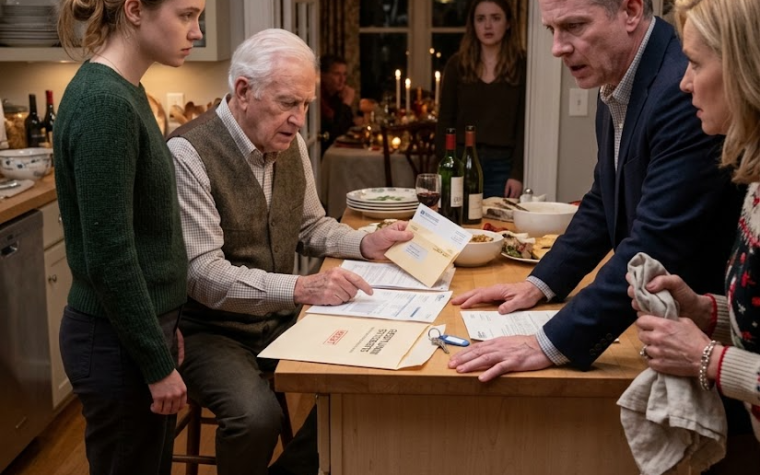
I stared at the certificate.
“I don’t know how to run a development company.”
“You do not have to,” Rachel said.
“But you have the right to prevent Richard from using it to harm you.”
The trust contained a special instruction.
If Richard or Evelyn attempted to remove me from the house, seize personal property, interfere with custody, or conceal estate records, Mark’s voting proxy would automatically pass to an independent fiduciary until a formal review of company conduct was completed.
Richard had activated that clause himself when he changed the locks.
The following morning, his attorney filed an emergency petition challenging the trust and asking the court to freeze my access to every account.
The petition described me as emotionally unstable, financially irresponsible, and incapable of protecting the children’s interests.
It also claimed Mark had lacked mental capacity when he signed the documents.
Rachel had expected every allegation.
At the emergency hearing two days later, Richard arrived in a dark suit with three attorneys.
Evelyn wore my absence of grief like an accusation, staring at me across the courtroom with her chin raised.
I wore the same wedding ring she had taken.
Richard’s lead attorney argued that Mark’s illness had made him vulnerable to manipulation.
He presented company records showing that Bennett Development had once paid property taxes and maintenance expenses on the house.
Rachel presented canceled checks proving Mark had reimbursed every payment.
She produced the recorded sale agreement, the wire transfer from Mark’s inheritance account, the deed, the trust certificate, and the medical capacity evaluation.
Then Dr.
Arjun Shah, Mark’s oncologist, took the witness stand.
“Was Mr.
Bennett confused on the day he signed these documents?” Rachel asked.
“No.”
“Did anyone pressure him?”
“No.
In fact, he requested that no family member be present because he feared interference.”
Richard’s attorney objected, but the judge allowed the answer.
A hospital social worker testified next.
She remembered Mark asking the same question three times: whether the trust would guarantee that his wife and children could remain in their home regardless of what his parents claimed.
“He was not vague,” she said.
“He was deliberate.”
Richard’s face reddened.
His attorney then argued that his comments on the porch had been misunderstood.
Rachel played Noah’s recording.
Richard’s voice filled the courtroom.
Take one more step, Laura, and I’m calling Child Protective Services.
They could be placed in foster care before dinner.
There was no concern in his tone.
No grief.
No hesitation.
Only power.
Rachel submitted the funeral home’s security video next.
It showed Evelyn gripping my hand, twisting my wrist, and pulling off the ring while mourners watched.
Evelyn looked away from the screen.
The judge denied Richard’s petition.
She confirmed my authority as surviving trustee, ordered the immediate return of every document and device removed from the house, and issued a temporary no-contact order preventing Richard and Evelyn from approaching me, the children, or the property.
Then she addressed the child-welfare threat.
“Grief is not parental unfitness,” she said.
“Standing in the rain because another person unlawfully changed your locks is not neglect.
The court will not tolerate the use of foster care as a weapon in a property dispute.”
For the first time since Mark died, I felt my lungs fill completely.
Outside the courtroom, Richard tried to corner Rachel near the elevators.
“You have no idea what you’re doing to my company.”
Rachel closed her folder.
“Mark’s company too.”
That afternoon, the independent fiduciary invoked the voting proxy and called an emergency board meeting.