The executive leaned closer, read one line, and suddenly stopped smiling.
His eyes moved back to the top of the document, then slowly down again, as though the words might rearrange themselves if he gave them enough time.
Tom Selleck kept one hand on the open blue folder.
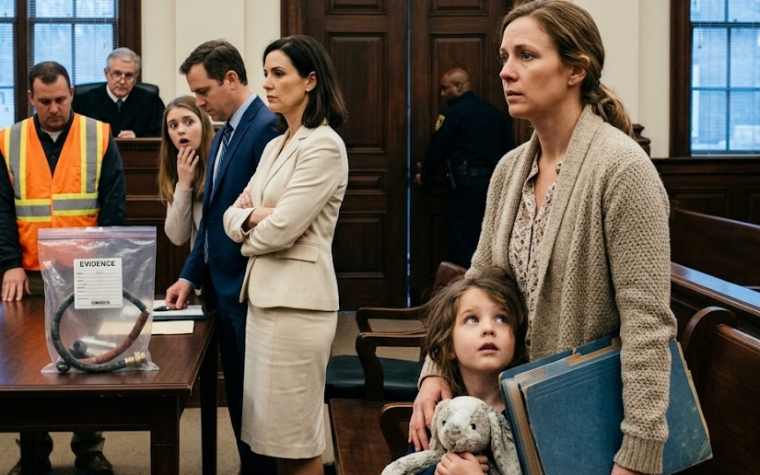
Around him, the cast and crew of Blue Bloods stood inside the half-dismantled Reagan dining room, watching the man who had ordered the set destroyed struggle to understand what he was reading.
The worker with the power drill lowered it to his side.
Donnie Wahlberg stepped nearer to the table.
“Well?” he asked.
The executive ignored him.
He turned the page and found another document bearing the same seal, followed by a list of signatures.
Tom’s name was first.
Bridget Moynahan’s appeared beneath it.
Then Donnie’s, Will Estes’s, Len Cariou’s, and the names of dozens of producers, camera operators, electricians, costume workers, set dressers, assistants, and crew members who had helped create the series over fourteen seasons.
The executive looked up.
“This can’t be valid.”
“It is,” Tom said.
“What exactly is it?” Bridget asked, although the small smile forming at the edge of her mouth suggested she already understood.
Tom turned the folder so everyone could see the bold heading, though no one needed to read every legal phrase to recognize the meaning.
It was a transfer agreement.
Three weeks earlier, when the final production schedule had been circulated, Tom had learned that the Reagan dining room would not be preserved.
The table, chairs, cabinets, framed photographs, serving dishes, and other set pieces had been categorized as ordinary studio assets.
Anything not claimed by another production would be dismantled, sold, recycled, or discarded.
He had not made a speech about it.
He had called Len first.
Len had been quiet for several seconds before saying, “That table belongs somewhere people can remember what happened around it.”
Then Tom called Donnie, who immediately offered to buy the entire room himself.
“It isn’t about one person buying it,” Tom had told him.
“It should belong to everyone who built it.”
Bridget suggested forming a preservation trust.
Will contacted members of the crew who knew which pieces were original and which had been replaced over the years.
Producers reached out to the studio’s legal department.
Quietly, without fanfare, the cast and crew pooled money and negotiated to acquire the dining-room set after filming ended.
The agreement had been approved the previous afternoon.
The executive standing beside the table had never been told.
He had received an older clearance order and decided to begin early.
“You had no authority to remove anything from this room,” Tom said.
The executive closed the folder too quickly.
“I received a signed disposal schedule.”
“Dated before the transfer,” Tom replied.
“The company still owns the building.”
“The building, yes.
Not this table.”
Donnie reached for the folder, opened it again, and scanned the page.
His expression changed from suspicion to disbelief and then to something warmer.
“You actually did it,” he said.
“We did it,” Tom corrected him.
The executive’s face hardened.
“This is a television set.
You’re behaving as if it’s a national monument.”
Len moved forward for the first time.
“No,” he said.
“We’re behaving as if fourteen years of people’s lives deserve more than ten minutes and a dumpster.”
The words landed heavily in the room.
Behind him, a set dresser covered her mouth.
She had spent years arranging the same serving bowls before every Reagan family dinner.
An electrician who had worked on the show since the first season wiped his cheek with the back of his hand and pretended to adjust his glasses.
The executive noticed their reactions and became defensive.