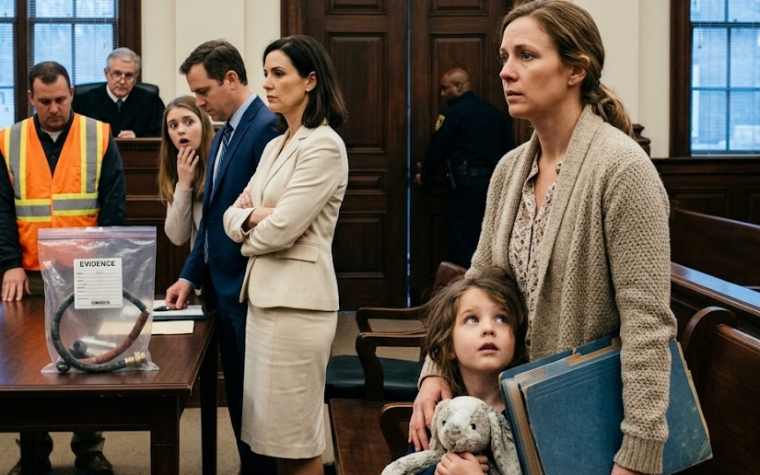
Carol tore the envelope open.
Dad moved so quickly his chair struck the floor behind him.
“Carol, give me that.”
She pulled the papers against her chest.
“No.”
The single word stopped him.
I remained near the French doors, my purse over one shoulder, while the room that had been arranged for a perfect family photograph quietly rearranged itself around a document no one wanted photographed.
The photographer looked toward the hallway as if wondering whether he should leave.
Blake stood beside his chair.
Sloane had gone completely still.
Dad’s phone was still connected to whoever had called him.
The voice on the other end spoke again, louder now.
“Robert? I need an answer.
The redemption notice is effective today.”
Carol heard it.
Her eyes flicked from the phone to me.
“Redemption of what?”
Dad ended the call.
That was his first mistake.
Until then, he could still pretend the crisis belonged somewhere outside that room.
Once he disconnected, every eye settled on him.
He reached toward Carol again.
“It’s complicated.”
She gave a short, humorless laugh.
Apparently that word had been doing a lot of work in my family that morning.
“Read it,” I said.
Dad turned toward me.
“Nora.”
“Carol wanted a simpler family story.
This should help.”
Carol unfolded the first page.
I knew what she was seeing because I had spent three nights reading the same language until I could recite parts of it from memory.
My mother had provided a substantial pool of investment capital during Anderson Hospitality Group’s expansion years.
It had not been a sentimental contribution, and it had not been a gift to my father.
The money had entered through a private investment vehicle with preferred rights, repayment protections, and a side agreement signed by Dad personally.
For years, I had believed the sanitized version he told me after my mother died: that her financial interests had been “consolidated” into the family business and professionally managed for everyone’s benefit.
That description was convenient.
It was also incomplete.
The Manhattan attorney had found the side agreement while reviewing old estate files connected to my mother’s holdings.
The beneficial interest had not passed to Dad.
It had passed to me.
Dad remained the public face of the hotel company.
He controlled operations.
He chaired meetings.
He stood beneath chandeliers cutting ribbons while business magazines quoted him about discipline and long-term thinking.
But a significant portion of the patient capital that had helped the company expand belonged, through my mother’s investment structure, to me.
And Dad had signed an acknowledgment of that fact.
Carol read the signature line twice.
Then she looked up.
“You told me this was yours.”
Dad’s jaw tightened.
“It effectively was.
I managed it.”
“That isn’t what this says.”
Blake stepped closer.
“What does it say?”