That part mattered.
I had not invented my financial independence in the hallway.
Long before the photograph, Martin and I had discussed whether remaining so heavily exposed to Dad’s company made sense.
The attorney’s discovery had accelerated the review.
The company was still valuable, but too much of my mother’s legacy remained tied to a business controlled by someone who treated transparency as optional.
I had delayed the decision because he was my father.
That morning had not created the risk.
It had removed my final excuse for tolerating it.
Dad pointed toward the phone.
“You don’t understand the consequences.”
“I asked Martin for the liquidity analysis six weeks ago.”
He froze.
Carol noticed.
“You planned this?”
“I evaluated it,” I said.
“There’s a difference.”
Dad’s anger sharpened.
“You are putting hundreds of employees at risk over a photograph.”
“No.”
I kept my voice level.
“You’re going to refinance an obligation your company always had.
You just preferred believing I would never enforce it.”
He stared at me.
The photographer quietly packed one lens into his bag.
It was such an ordinary sound—the click of a plastic lens cap—that I almost smiled.
The family portrait was clearly over.
Dad’s phone rang again.
This time he answered.
“Yes.”
He listened.
“No, do not circulate anything yet.”
Another pause.
“I said do not circulate it.”
Whoever was speaking apparently did not agree that Dad could control the timetable.
He walked toward the far end of the room, but there was nowhere far enough to go.
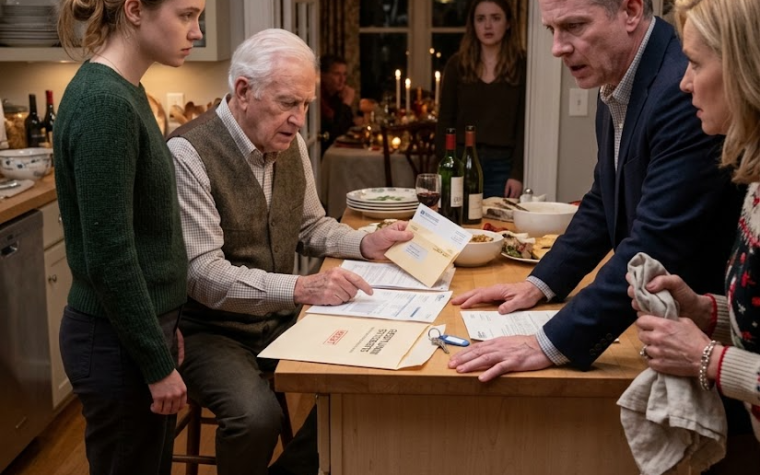
Carol continued reading.
Then she reached the page my text to Dad had referenced.
The first page I had sent electronically that morning showed three things clearly: my mother’s name, my father’s signature, and the clause confirming that the beneficial owner—not company management—controlled the redemption right.
The remaining pages were worse for him because they documented years of amendments.
Each time the company had asked the investment vehicle to extend capital, Dad had signed again.
He had known exactly whose economic interest he was dealing with.
He had simply never explained that to Carol.
She lifted one amendment.
“This is from four years ago.”
Dad kept speaking into his phone.
“And this one is two years ago.”
He turned away.
Carol’s voice rose.
“Robert.”
He ended the second call.
“What?”
“You told me Nora’s mother’s estate was settled before we married.”
“It was.”
“Then why were you signing extensions connected to her capital after we married?”
He looked at me as if I had authored the paperwork myself.
“The investment remained in place.