The bay was dark beyond the guardrail, and the party lights were visible in the distance across the water.
“This isn’t about winning,” I said.
“You planted this because you hate me.”
“I brought evidence of what you did.”
“You don’t know anything about the deal.”
“I know Brooke’s signature wasn’t yours to use.”
His breathing grew louder.
“You’ve always wanted what I have.”
That sentence almost made me laugh.
I thought about the college folder.
The crashed cars.
The excuses.
The folding chair beside the trash cans.
“No, Dylan,” I said.
“I wanted parents who noticed what you were taking from me.
Brooke deserves to notice what you’re taking from her.”
He threw the phone.
I heard it strike the table, followed by gasps and the crash of a champagne glass.
Brooke picked it up.
“Come back,” she told me.
I hesitated.
“You don’t need me there.”
“Yes,” she said.
“I do.”
I turned the Accord around.
While I drove back toward the island, Brooke stopped the party.
She instructed the staff to shut down the music and asked the guests to remain while she contacted the people responsible for the property transaction.
She froze every transfer she had the authority to stop and warned the financial institutions that her identity and signature had been used without permission.
Dylan moved from denial to bargaining.
He told her he had only been trying to protect their future.
He claimed the shell company allowed him to move faster than traditional lenders.
He promised the money would have been returned after another investment paid off.
That admission ended any remaining doubt.
Brooke asked how much of the money was gone.
Dylan said it wasn’t gone.
She asked where it was.
He refused to answer.
My father tried to guide him away from the guests, but Brooke ordered security not to let Dylan leave until the laptop and transaction records had been secured.
My mother began crying.
Not for Brooke.
Not for me.
For Dylan.
She kept saying he had made a mistake and that one mistake shouldn’t destroy his life.
Brooke looked at her and said, “Seven forged documents are not one mistake.”
When I returned to the compound, the folding chair was still beside the trash cans.
No one laughed when I walked past it.
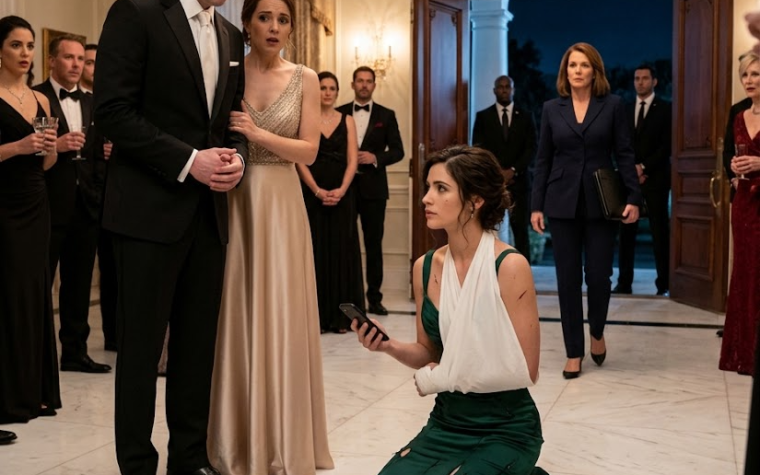
The terrace looked different without music.
Half-full champagne glasses sat abandoned on the tables.
Guests stood in tense clusters.
The string quartet had packed away its instruments.
Dylan was near the screen with two guards beside him.
His bow tie hung loose, and the confidence he had worn all evening had collapsed into anger.
The moment he saw me, he lunged forward.
The guards stopped him.
“You ruined everything,” he shouted.
I took the black USB from the laptop and handed it to Brooke.