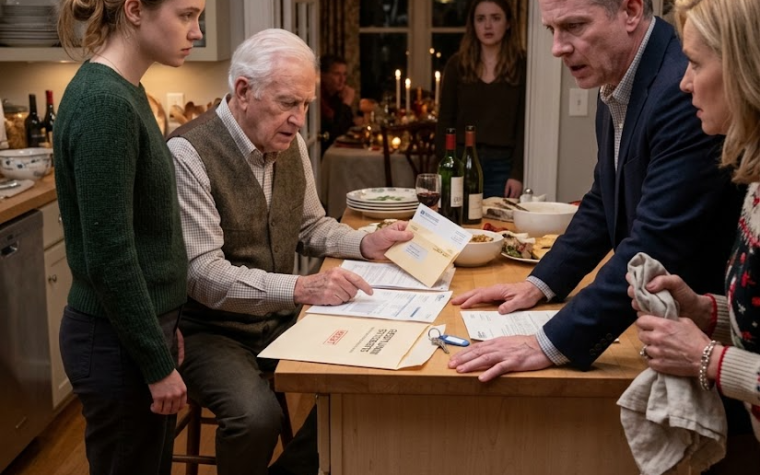
“I’m not going to be interrogated in my own house.”
There it was.
My own house.
I rested one hand on the leather folder.
“You should be more careful with that phrase tonight.”
He laughed once, but it sounded forced.
“What is that supposed to mean?”
“It means you should go upstairs, sleep in the guest room, and be at the downtown office at nine tomorrow morning.”
“You don’t summon me to my own office.”
“Nine o’clock, Preston.”
His eyes narrowed.
For years, I had watched people mistake my quietness for dependence.
Preston had made the mistake more completely than anyone.
When my father died, Preston stepped forward publicly.
He handled interviews.
He attended development conferences.
He stood beside architectural models and spoke about “our vision” until reporters began describing Whitaker Development as the company he led.
I let him.
I was raising Henry.
I preferred strategy to cameras.
I had no interest in competing with my husband for headlines.
Preston slowly began treating visibility as ownership.
The larger his title became in his own mind, the less he remembered why he had that title in the first place.
My father had never transferred control of Whitaker Development to him.
Neither had I.
Preston had operating authority.
He could negotiate within limits, manage teams, recommend acquisitions, and represent the company publicly.
But the controlling interest created by my father’s estate remained mine through the Whitaker family structure.
Preston’s power existed because I had trusted him with it.
Trust could be withdrawn.
He picked up his keys.
“I’m not sleeping in the guest room.”
“Then sleep somewhere else.”
His jaw tightened.
“Brooke was right about one thing.
You’ve become impossible.”
I felt the sentence land.
Then I remembered Henry staring at the door while five candles burned down on his cake.
“Good night, Preston.”
He stared at me, waiting for tears, anger, pleading—some familiar proof that he still controlled the emotional temperature of the room.
I gave him none.
Eventually he went upstairs.
At 6:12 the next morning, Samuel called.
I was already awake.
He had spent the night reviewing the authority documents attached to Preston’s executive role and coordinating the first stage of an internal audit.
“We can suspend discretionary approval immediately,” he told me.
“Anything requiring ownership authorization is already outside his reach.
For the rest, we document first and act through the company’s governance process.”
“Do it cleanly.”
“Always.”
Then his voice became more serious.
“There’s something else.”
I looked through the bedroom window at the garden where workers were collecting deflated birthday balloons.
“Tell me.”
“Preliminary expense records show repeated California travel connected to the development division.
Some of it may be legitimate.