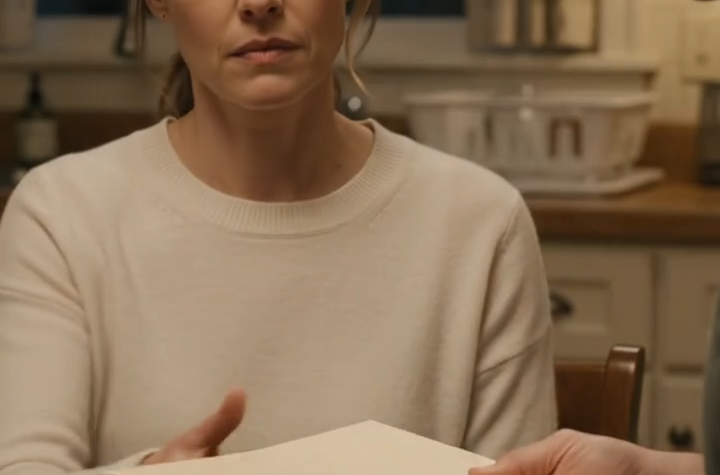
This looked like a child finally setting down something much too heavy for him.
“Where’s the silver thing?” he asked.
“The police have it.”
“Will they give it back?”
“Probably not for a while.
It’s evidence.”
He considered that.
“Good,” he said.
“Then she can’t break it.”
The criminal case lasted more than a year.
Martha’s attorney argued that the recording lacked context.
He suggested the boy had behavioral problems, that the basement had been used for safety, and that the homemade cast was a panicked mother’s attempt to help when she could not afford another medical bill.
The financial argument collapsed when prosecutors introduced bank records showing recent luxury purchases and regular salon appointments.
The medical argument collapsed when the surgeon testified that no reasonable person could mistake a blue hand, high fever, foul odor, and worsening swelling for normal healing.
Then the recording was played in court.
The jurors heard Martha tell her son that no doctor would see the lock.
They heard him ask for water.
They heard her tell him he could drink when he stopped trying to escape.
Martha looked down throughout the playback.
The boy did not attend.
A child advocate read his statement instead.
It contained no dramatic speech and no demand for revenge.
He wrote that he had hidden the recorder because he thought doctors believed adults first.
He wrote that when I touched his shoulder in Trauma Room 2, he knew I had smelled the truth even before I found it.
Martha was convicted.
The sentence could not return the month he spent in the basement.
It could not restore perfect movement to his fingers or erase the memory of metal tightening around his wrist.
But it removed her power to call his pain a lie.
That mattered.
Nearly ten months after the day he arrived, the boy returned to the hospital for a follow-up visit.
He was taller.
His face had filled out.
His hair had grown long enough to fall over his eyes.
A slim removable brace covered his right wrist.
This one was clean.
He found me near the nurses’ station and held up his hand.
His fingers opened slowly, then closed around a small rubber therapy ball.
“Twenty times every hour,” he said.
“You’ve been doing them?”
“Mostly.”
Clara appeared behind me.
“Mostly means twelve.”
The boy smiled.
It was the first time I had seen him look his age.
He reached into his pocket with his good hand and gave me a folded piece of paper.
For one terrible second, I thought of the note sealed inside the cast.
This paper was different.
It was covered in blue marker and crooked block letters.
It said: “Thank you for opening it.”
I had spent three years carrying the memory of the child whose warning signs I had missed.
I had turned that memory into rules: look again, ask one more question, never let an adult’s confidence become a substitute for a child’s safety.
Rules do not erase old failures.
But sometimes they stop the next one.
I looked at the boy’s slowly moving fingers, the clean brace, and the therapy ball held tightly in his palm.
The most important thing we removed that afternoon was not the filthy fiberglass.
It was the story Martha had built around him—the clumsy child, the mild fever, the worried mother, the imaginary surgeon, the harmless accident in a tree.