They would hide in an abandoned railway pump house beyond the western creek.
Emily had found it during a bike ride months earlier.
They would spend the night there, return at sunrise, and announce that Nora would run away again unless she was allowed to stay near us.
Emily had even written a note explaining everything.
She had hidden it beneath her mattress, where no one found it during the frantic first search of her bedroom.
Years later, after the house had been searched repeatedly, the paper had apparently become lodged behind the wooden bed frame.
Nora had found it only three days earlier when she finally moved Emily’s bed to clean beneath it.
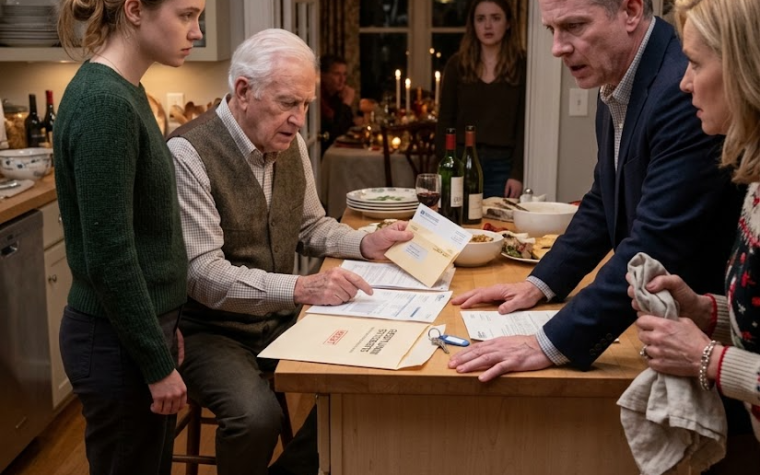
That was the note inside the envelope.
Nora knows the plan.
The rest of the message had been torn away by a rusted nail.
Nora continued.
The girls reached the creek shortly after sunset.
The temperature dropped faster than expected, and a light rain began.
Nora became frightened and begged Emily to turn back.
Emily refused.
“She said we had to stay gone long enough for people to listen,” Nora told me.
“We argued near the old footbridge.”
The bridge crossed a narrow channel that fed into the larger creek.
It had been condemned years earlier, but children still used it as a shortcut.
Emily crossed first.
Halfway over, one of the wet boards cracked beneath her.
She dropped through the gap, struck the embankment, and rolled into the darkness below.
Nora scrambled down after her, calling her name.
She found disturbed mud, broken branches, and one shoe print leading toward the service road.
She heard Emily shout once from somewhere beyond the trees.
Then a truck engine roared in the distance.
Nora followed the sound but became lost.
By the time she reached our porch, she was soaked, freezing, and convinced Emily had already found another way home.
When I asked where Emily was, Nora remembered the promise they had made.
They were not supposed to reveal the pump house until morning.
So she said, “I don’t know.”
By midnight, when Emily still had not returned, Nora understood something was terribly wrong.
But police officers were already questioning her.
My brother was already calling her a liar.
Adults spoke over her, around her, and about her as if guilt had been established by the mud on her shoes.
She became afraid that admitting the plan would make everyone believe the disappearance had been deliberate.
She told police they had walked east toward the neighborhood trail.
The pump house was west.
Search teams did eventually reach that area, but not until the following afternoon.
Heavy rain had washed away footprints along the service road.
“What happened after the fall?” I asked Emily.
She pressed her fingertips against the scar beneath her chin.
“I remember the bridge breaking,” she said.
“Then I remember headlights.”
A road maintenance crew had found her wandering near a rural highway almost twenty miles from town shortly before dawn.
She had a concussion, a fractured wrist, and no identification.
She could say only part of her first name.
“Em,” she had repeated when asked who she was.
The hospital registered her as an unidentified minor.
A clerical error listed her estimated age as sixteen instead of thirteen.
Another mistake recorded the date she was found one day later than the date on Emily’s missing-person bulletin.
The mistakes should not have been enough to lose a child.
But the rural hospital transferred her to a youth facility outside the region before investigators connected the reports.
Her memory returned in fragments, not in a single dramatic moment.
She remembered a kitchen clock but not the town.
A pink scarf but not the street.