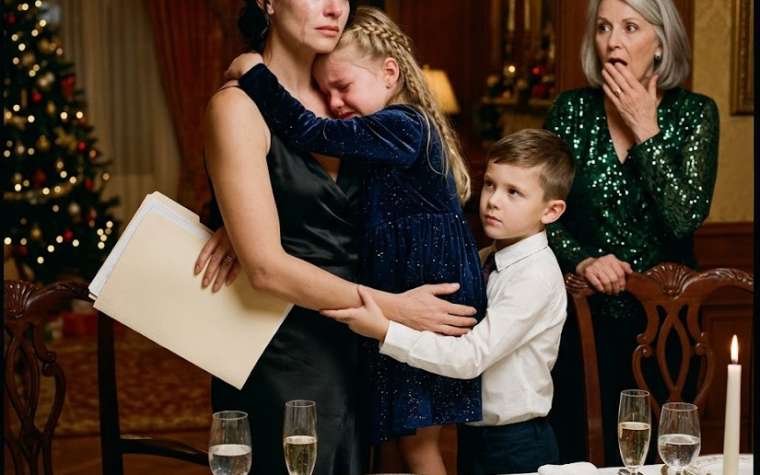
You will not go home with her.
Noah’s lower lip trembled.
Never?
Never.
The police escorted Vanessa from the restaurant after she refused to cooperate and attempted to delete messages from her phone.
She was not convicted that night, and Daniel did not pretend that wealth could turn an accusation into an instant verdict.
But the video, the false messages, the missed appointments, the locked tablet, and the statements from Noah and Maya were enough for authorities to open a formal neglect investigation.
Daniel filed for an emergency protective order before midnight.
Vanessa was barred from contacting Noah while the investigation continued.
Over the following weeks, more evidence emerged.
Former household employees described how Vanessa had discouraged them from interacting with Noah.
A former babysitter produced messages in which Vanessa ordered her not to give him snacks unless he “behaved normally.” The clinic documented repeated cancellations.
Home security footage showed long periods when Noah’s bedroom door remained locked from the outside.
Vanessa’s attorneys argued that she had been overwhelmed.
The investigators acknowledged that caregiving could be difficult.
They also made clear that difficulty did not excuse deliberate isolation, deprivation, deception, or abandonment.
Daniel cooperated with every inquiry, including the uncomfortable questions about his own absence.
He reduced his travel.
He moved important meetings to video calls.
He hired qualified caregivers recommended by Noah’s medical team, but he did not use them as replacements for himself.
Most importantly, he began learning sign language properly.
At first, Noah corrected him constantly.
Daniel confused “later” with “yesterday.” He signed “school” when he meant “work.” Once, while attempting to ask whether Noah wanted pancakes, he accidentally asked whether Noah wanted a flat tire.
Noah laughed so hard that no sound came out, his shoulders bouncing as Daniel stared in confusion.
It was the first time Daniel had seen him laugh in months.
Maya and Hannah remained part of Noah’s life, though Hannah insisted that gratitude could not become ownership.
When Daniel offered her money, she shook her head.
“My daughter helped your son because he needed help,” she said.
“Do not turn her kindness into a transaction.”
Daniel respected that.
Instead, after learning that Hannah had lost her job during treatment, he asked Mrs.
Romano whether the restaurant needed help with bookkeeping that could be done from home.
Mrs.
Romano did.
Hannah accepted the work because it was real work, paid fairly.
Daniel also arranged transportation so Maya no longer had to walk alone through the district at sunset.
Hannah accepted only after Maya pointed out that refusing safe transportation would not make them more dignified.
“People helping people is not shame,” Maya reminded her.
Hannah smiled despite the tears in her eyes.
Months later, the court granted Daniel full protective custody while Vanessa faced charges connected to child neglect, evidence tampering, and falsified records.
The divorce proceeded separately.
Daniel removed every photograph from the charity campaigns that had presented Vanessa as Noah’s devoted advocate.
He also ordered an independent review of his company’s disability programs, realizing that public donations meant little if he could overlook exclusion inside his own home.
He did not make Noah’s suffering into a press release.
The alley video remained evidence, not publicity.
One evening, nearly a year after Maya first found Noah, Daniel brought him back to Romano’s.
Not to the alley.
They entered through the front door.
Noah wore the same navy sweater, now slightly too small.
Maya sat at a corner table with Hannah, whose face had regained some color.
Mrs.
Romano carried out a bowl of pasta large enough for everyone.
Noah ran to Maya and signed so quickly that Daniel could barely follow.
I ate lunch.
I went to school.
Daddy signed the wrong word again.