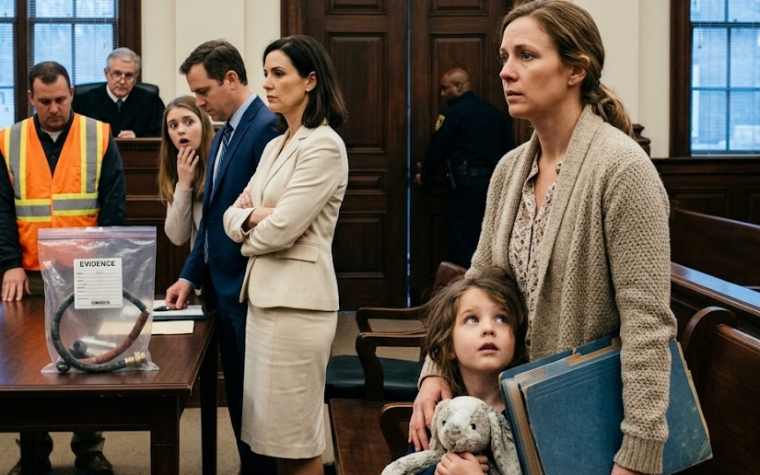
The first page inside the blue folder was a document I had never seen, but my name was printed across the top.
NOTICE OF ADMINISTRATIVE SEPARATION.
The words were slightly blurred from repeated copying.
Beneath them sat a fabricated account of a recruit who had failed to adapt to military life, abandoned her training, and been released after an emotional breakdown.
That recruit was supposed to be me.
The prosecutor asked me to examine the document carefully.
“Commander Mitchell, is this an authentic Navy record?”
“No.”
“Were you separated on the date shown here?”
“No.
On that date, I was completing training at Great Lakes.”
“Did you authorize anyone to create this document?”
“No.”
I looked toward Tom.
He was staring down at the defense table, but I could see the pulse moving in his neck.
Behind me, my mother began to cry.
The prosecutor displayed my certified service history.
It showed uninterrupted active duty from the day I enlisted through the morning of the court-martial.
Training commands, ship assignments, deployments, evaluations, promotions—twelve years of official records lined up in clean chronological order.
There was no discharge.
No failed training.
No break in service.
The judge examined the record before allowing it into evidence.
My father whispered, “Oh, God.”
Tom’s attorney objected again.
He argued that an old family dispute could prejudice the court against his client and had no connection to the current accusations involving forged travel authorizations and housing claims.
The prosecutor answered calmly.
“The connection is contained in the digital evidence.”
A Navy forensic investigator took the stand after me.
She explained that investigators had seized Tom’s personal computer while examining a series of suspicious reimbursement claims.
Several approval signatures appeared identical even though they had supposedly been written months apart by different officers.
Tom had claimed that administrative personnel must have copied the signatures by mistake.
The forensic review showed otherwise.
Investigators recovered editing templates, scanned signatures, altered forms, and deleted versions of documents used to support his claims.
Buried inside an old cloud archive was the false separation notice carrying my name.
The file had been created twelve years earlier.
Its original author field contained Tom’s personal username.
The same editing program, formatting habits, and scanned signature technique appeared in the documents listed in his current charges.
Tom leaned toward his attorney and spoke rapidly.
His attorney’s face tightened as he listened.
The prosecutor asked the investigator whether one file alone had connected Tom to the lie.
“No, ma’am.”
A second exhibit appeared on the courtroom monitor.
The visible details had been enlarged for the court, though I could barely bring myself to look at them.
It was a folder directory recovered from Tom’s cloud storage.
Inside were drafts of messages written in my voice.
I’m sorry I disappointed you.
I couldn’t handle the pressure.
Please don’t contact the command.
I don’t want anyone else knowing.
The messages had never been sent from my accounts.
Tom had created them to show our parents whenever they questioned his story.
My mother covered her face with both hands.
I remembered her voice on the phone during training.
Tom said you called him.
He said you couldn’t handle it.