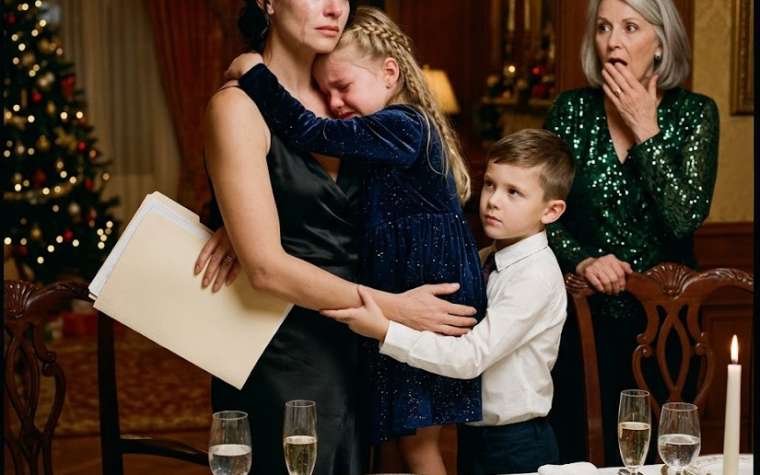
I told the court about the half-open door, my mother’s frightened face, and Tom appearing in the hallway.
“Still wearing the costume?” I repeated.
Tom shook his head.
“I never said that.”
The judge warned him not to interrupt.
The prosecutor handed me my father’s final letter.
I had preserved it inside a plastic sleeve for a dozen years.
Until you admit the truth, do not contact us again.
My father lowered his head as the words were read aloud.
“Did you stop contacting your parents after receiving this?” the prosecutor asked.
“Yes.”
“Why?”
“Because every attempt to prove I was serving was being treated as another lie.
I had a duty to perform and, later, a child to protect.
I could not spend my life begging outside a locked door.”
Tom’s attorney approached me carefully during cross-examination.
“You resent your brother, don’t you?”
“I know what he did.”
“That was not my question.”
“I resented losing my family.”
“And you blame him for everything?”
“No.”
The answer made my mother look up.
I continued before the attorney could move on.
“My parents made their own decisions.
Tom created the lie, but they chose not to verify it.
Both things are true.”
The attorney glanced toward Tom, perhaps expecting him to appreciate the distinction.
Tom looked furious.
The attorney then suggested that I had exaggerated the estrangement to damage my brother’s case.
I reached into my folder and removed copies of phone records, returned envelopes, and the certified service documents I had sent home during my first two years in the Navy.
“I kept the evidence because no one in my family would look at it.”
The prosecutor later called my mother as a rebuttal witness.
She walked to the stand unsteadily and gave her name in a voice I barely recognized.
She admitted that Tom had been the first person to tell them I had quit.
He had shown them the false separation notice and several fabricated messages.
Whenever I called, he warned them that I was trying to manipulate them.
“Why didn’t you contact her command?” the prosecutor asked.
My mother’s eyes found mine.
“Because Tom said it would humiliate her and damage his own future in the Navy.
He said the family needed to keep it quiet.”
“Did Commander Mitchell give you contact information?”
“Yes.”
“Did you use it?”
“No.”
“Why not?”
My mother swallowed.
“Because believing Tom was easier.”
The answer struck harder than any excuse could have.
She described him as confident, admired, and persuasive.
He had always been the child who seemed certain.
I had been the quieter one, the one expected to endure disappointment without making a scene.
Tom understood that imbalance and used it.
When my father testified, he did not try to defend himself.
He admitted seeing me outside the house in uniform.
He admitted refusing to call the number I gave him.