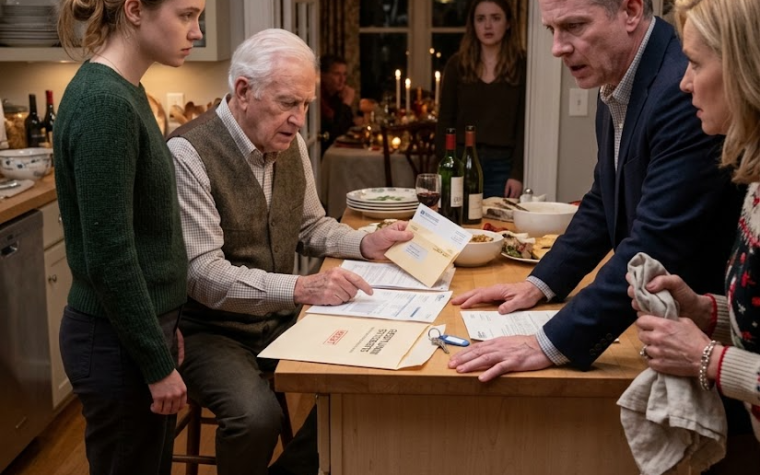
I looked at him.
“Mom didn’t hire Navaro.”
His eyes dropped.
He had no answer.
So I reached into my bag and took out the small envelope I had found beneath the church cards.
I did not hand it to him.
I only showed him my name in my mother’s shaky handwriting.
“She knew you might turn on me,” I said.
His face tightened.
“What does it say?”
“That truth doesn’t ask for permission.”
For once, he did not call her confused.
He did not call me manipulative.
He simply stared at the envelope.
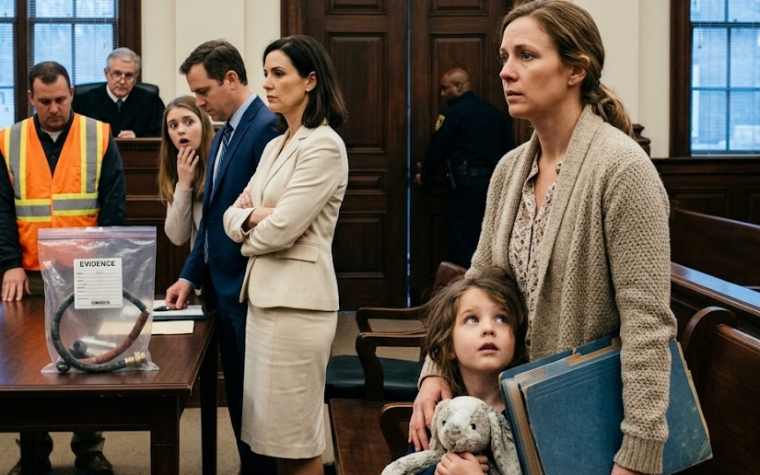
The final hearing came two days later.
By then, Navaro was no longer sitting comfortably beside my father.
Separate counsel had appeared to advise him regarding the court’s referral of the recording issue.
The judge had also sent notice to the appropriate professional and federal authorities for review of how restricted hospital material had been obtained and used.
She made clear that those bodies, not her probate courtroom, would decide whether additional violations had occurred.
But she could decide what happened to the will challenge.
And she did.
Judge Wexler found that my father had failed to establish that I coerced my mother or improperly caused the estate changes he challenged.
She noted that several allegations were contradicted by documented service records, that the most emotionally damaging recording had been presented without context, and that the circumstances surrounding its acquisition raised substantial credibility concerns.
The challenge was denied.
No cheering followed.
Real life rarely gives you music when a burden finally lifts.
There was only the sound of papers moving, a chair scraping, someone coughing in the back row.
My father sat with his eyes fixed on the table.
He had spent months insisting that court would expose me.
Instead, it exposed how little he knew about his own daughter and how quickly he had trusted a man who offered him a version of me cruel enough to fit his anger.
Navaro gathered his papers without looking at anyone.
As he passed my table, he paused.
“You always did know how to make a record look devastating,” he murmured.
I met his eyes.
“No,” I said.
“I just don’t edit it.”
He walked out.
Weeks later, I learned that the authorities were reviewing the access trail connected to the hospital recording and Navaro’s handling of it.
I was not told every detail.
Some of the material remained restricted, and I had spent enough years around investigations to know the difference between suspicion and a finding.
But his involvement in my father’s case was over.
That was enough for me.
The harder question was what to do with Miguel.
He called three times before I answered.
The first conversation lasted less than five minutes.
He did not apologize correctly.
People imagine apologies arrive polished when shame finally wins.
They usually do not.
He started with explanations.
“I was grieving.”
“I thought your mother had shut me out.”
“Navaro showed me things.”
Each sentence placed responsibility somewhere nearby without setting it down in his own hands.
I let him finish.
Then I said, “You called me a disgrace in a room full of strangers.”
Silence.