“You could have found me later,” I said.
Frank lowered his eyes.
“I tried once.”
Six months after I left, he had gone to the bus station with cash and a note.
The black SUV followed him from the plant.
That same evening, someone broke into our house and placed one of my childhood photographs on his pillow.
After that, he stopped trying.
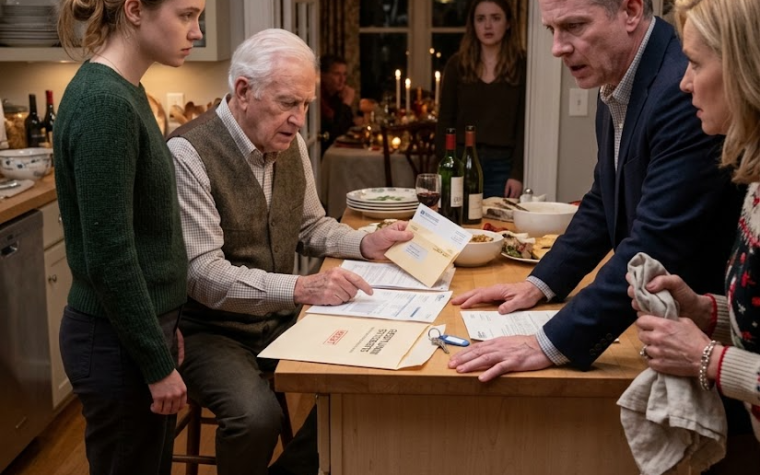
Diane pressed the bloodstained envelope flat.
“You both deserve the rest,” she said.
She opened it.
Inside was a folded sheet of paper, a small brass key, and a strip of cloth stained brown with age.
The cloth had been torn from the sleeve Elias wore in the photograph.
The message was brief.
Elias had written it while injured, after escaping a confrontation inside the plant’s records building.
He told Diane that the owner knew about the copied emission logs.
He warned her not to trust any report claiming that he had left Albany voluntarily.
At the bottom, he had written three instructions.
Protect Hannah.
Protect the child.
Do not let them erase the original charter.
Frank gripped the edge of the table.
“What charter?” I asked.
Diane pointed to the brass key.
Elias’s father had helped establish Silver Creek decades earlier.
The original company charter placed the Ward family’s controlling shares inside a trust.
Those shares could not be sold or transferred outside the founder’s direct bloodline.
When Elias’s father died, the plant’s current owner—his former business partner—claimed Elias had signed away his inheritance.
Elias insisted the signature was forged.
He had discovered the original trust documents in an abandoned records locker beneath the plant’s first administration building.
If he died, his lawful shares would pass to his child.
To Owen.
The plant owner had not merely been hiding pollution.
He had stolen control of Silver Creek, falsified safety reports, and diverted the company’s environmental reserve into private accounts.
That reserve had been created to contain spills, replace filtration systems, and compensate sick workers.
Without it, Albany’s soil, wells, and air had been left to deteriorate.
Elias had wanted to reclaim the company long enough to shut down the illegal production lines and release the reserve money for cleanup.
My pregnancy changed everything.
An unborn heir gave him someone to protect—and gave the owner another person to eliminate.
I removed the USB drive from my folder.
Elias had given it to me three nights before he vanished.
He told me it contained copies of everything he had found, but the files were encrypted.
For ten years, I had tried passwords based on dates, places, and private memories.
Nothing worked.
Diane turned over the final page of the message.
On the back, Elias had written one sentence.
The river remembers what the smoke hides.
I stared at the words.
Silver Creek emptied into the Albany River.
Elias had once taken me there during winter, when the banks were frozen and the plant’s orange lights reflected in the water.
He had called the place by an old name printed on his father’s maps.
“Ward Crossing,” I said.
I entered the phrase into my laptop.
The drive opened.
Folders appeared across the screen: emission records, internal emails, payment ledgers, laboratory results, and photographs taken inside sealed processing rooms.
There were videos of valves being opened after midnight.
There were spreadsheets comparing the plant’s public reports with the actual quantities released.