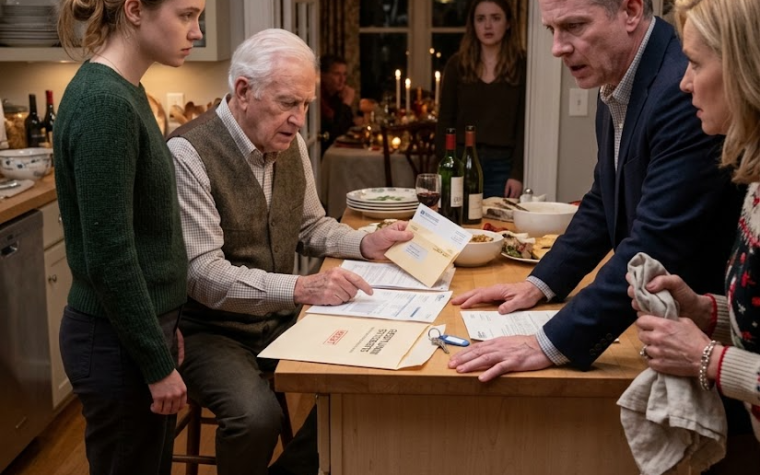
The investigator answered.
I stated my name, our address, and the fact that two representatives of Silver Creek had entered without permission while we were reviewing evidence connected to illegal emissions and a missing employee.
The men stopped.
Sirens sounded less than a minute later.
They had not been sent only for us.
State officers were already moving toward the plant after the law clinic verified the first set of records.
The investigators had been waiting for confirmation that the original files were authentic.
The owner tried to deny everything.
He called the videos fabricated.
He claimed Elias had forged the charter.
He accused Frank of stealing company property and me of inventing a paternity story to seize a valuable business.
Then the evidence began to close around him.
The brass key opened the abandoned locker beneath the old administration building.
Inside, investigators found the original trust charter, Elias’s handwritten notes, sealed water samples, and a second storage drive.
The charter carried signatures from witnesses who were still alive.
Ink analysis showed it predated the forged amendment by more than twenty years.
The plant’s own archived payroll records proved Elias had been working the night he supposedly fled Albany.
Blood recovered from the service corridor matched the stain on his torn sleeve.
The payment ledger connected the owner to the men who had followed our family.
Most damaging of all, the second drive contained recordings Elias had made during meetings with the owner.
In one, the owner ordered the nighttime release of untreated chemicals because shutting down the line would cost too much.
In another, he said sick workers could be replaced more cheaply than the filtration system.
Frank agreed to testify.
Diane surrendered the final message.
I provided the financial analysis showing where the cleanup reserve had been hidden.
A court ordered DNA testing using a preserved personal item recovered from Elias’s locker.
The result confirmed what I had always known: Owen was his son.
The trust recognized Owen as Elias’s legal heir.
Because he was a minor, I became temporary custodian of the shares under court supervision.
I could not sell the plant or take its money for myself.
I could, however, vote to remove the owner, freeze unauthorized payments, and place Silver Creek into an independent receivership.
My first vote shut down the illegal production lines.
The second released the environmental reserve for emergency filtration, soil testing, and medical screening.
The plant did not close forever.
Too many families depended on it.
Instead, the court-appointed team rebuilt the systems Elias had wanted repaired, reduced production, and opened the records to public inspection.
Workers who had been threatened were protected when they testified.
The former owner was charged with fraud, obstruction, evidence tampering, and environmental crimes.
The two men who entered my parents’ house were charged as well.
Investigators later located Elias’s remains near a disused service road beyond the plant’s southern fence.
He had never abandoned me.
He had never escaped.
He had died trying to keep the evidence out of the owner’s hands.
Albany did not heal overnight.
Poison does not leave soil because a judge signs an order.
Families still mourned people they believed should have lived longer.
Children still carried inhalers.
Empty shops did not suddenly reopen.
But the orange haze began to disappear.
The town installed new air monitors whose readings could be viewed by everyone.
A medical clinic opened inside the old company training center.
Compensation payments began reaching workers whose diagnoses had been buried or misreported.
Frank and I repaired our relationship more slowly.
I did not tell him that terror excused everything.
He had saved my life, but he had also left me alone when I needed him.
Both truths belonged in the room.