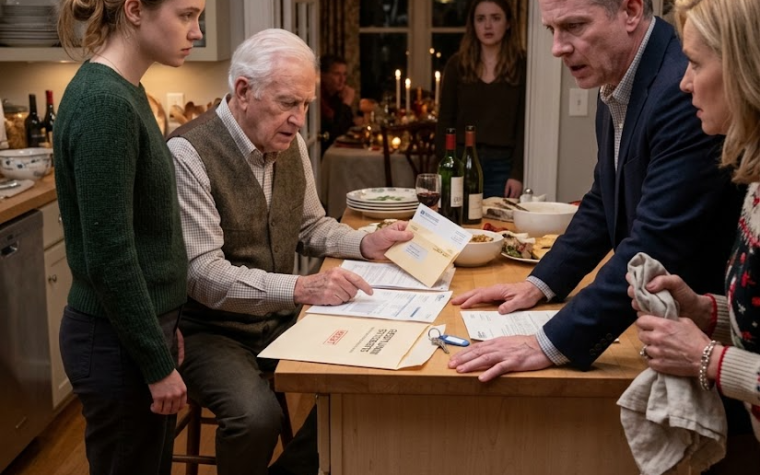
There was more.
My grandmother had appointed Martin as successor trustee if my father’s authority ended or was challenged.
“Why would she add that?” I asked.
Martin exhaled slowly.
“She was concerned about his handling of money.”
I almost laughed, but there was nothing funny about it.
“Did she say why?”
“She mentioned your college savings.”
The room seemed to narrow.
My college savings had disappeared when I was nineteen.
My parents told me the market had fallen and there wasn’t enough left.
Years later, I learned the account had been liquidated, but every time I asked for details my father accused me of being ungrateful.
“My grandmother knew?”
“She suspected.”
I covered my mouth with my hand.
For years I had carried that loss as if I had somehow failed to understand money, failed to plan, failed to appreciate sacrifice.
My grandmother had seen enough to build protections into her estate.
“What happens now?” I asked.
“Now we find out whether Robert followed the trust.”
Martin requested statements from the trust’s property account and contacted the county recorder.
The first result came back before dinner.
There had been an attempted home-equity filing four months earlier.
It had not completed because additional beneficiary consent was required.
My consent.
I had never been asked.
The application listed Robert Mitchell as trustee.
His authority had expired four months before he submitted it.
I felt cold despite the warm kitchen.
“How much?”
“Forty-five thousand dollars.”
I stared at the number.
My father had just threatened me over a $2,300 cruise upgrade.
But the house was the real story.
Martin asked whether my father had ever sent me documents to sign relating to the property.
I searched my email.
There it was.
Six months earlier, my mother had sent a message titled INSURANCE UPDATE.
She said the house needed a routine signature for a policy renewal.
I had been busy preparing for the baby and never opened the attachment.
Now I did.
It wasn’t an insurance form.
It was a beneficiary consent page connected to a lending application.
My signature line was blank.
I had never signed it.
But someone had tried to obtain my signature without telling me what I was authorizing.
The next morning, my father changed tactics.
His message was suddenly polite.
“Rachel, your mother and I think there’s been a misunderstanding.
Call me so we can clear this up privately.”
I did not call.
Twenty minutes later, my mother wrote:
“We are family.
Family doesn’t involve banks and lawyers.”
That sentence made something in me settle.
Family, apparently, could ignore a woman six days after surgery.
Family could leave her to find her own ride home from the hospital.