Then the officer asked whether I had requested a ride to the hospital.
There was a pause.
Ethan admitted that I had.
He insisted he did not realize I was seriously hurt.
Then they asked whether he had told me to remain on the kitchen floor until the next day.
Another pause.
By the time he answered, his confidence was beginning to crack.
His mother denied everything.
She said I had fallen.
She said I had always been dramatic.
She said the entire family had spent years trying to help me.
But investigators were now working backward from documentation created before any of them knew exactly how much had been recorded.
The hospital notes established what I said before speaking with Ethan again.
The emergency call established what Mrs.
Greene saw.
Her camera established when and how I reached her house.
My messages established Ethan’s concern with embarrassment and apology rather than my condition.
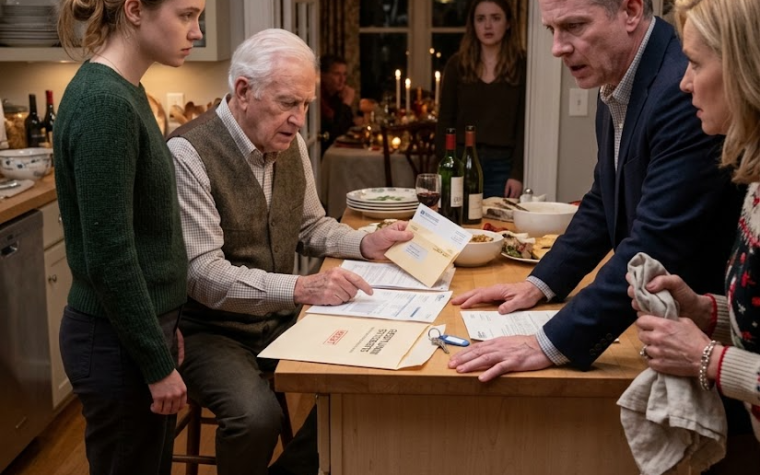
And then there was my father-in-law.
For two days, he supported Ethan and his wife.
He told police he had been in and out of the room and could not say exactly what happened.
The officer interviewing him apparently asked a simple question.
“If you didn’t see anything, how did you know there had been an argument?”
That was the first crack.
The second came when they asked whether he had seen me on the floor.
He admitted he had.
“Was she standing when your son came into the kitchen?”
“No.”
“Did she ask him for medical help?”
Another long silence.
Finally, he said yes.
That single answer destroyed the version Ethan had been trying to build.
My husband had not misunderstood.
He had known I was asking for a hospital.
He had made a decision not to help.
When Ethan realized his father had confirmed that much, his messages changed.
The apologies began.
Elena, please answer.
I was angry.
I handled it badly.
Don’t let strangers destroy our marriage over one terrible night.
One terrible night.
I read those words from my hospital bed and thought about all the nights that had led to it.
Every dinner where his mother insulted me and Ethan called it a joke.
Every time he told me that keeping peace meant letting his family win.
Every time I questioned something and he said I was disrespectful.
Every apology I gave just to end an argument I had not started.
The kitchen floor had not created our problem.
It had only made the problem impossible for me to rename.
The hospital social worker connected me with an advocate who helped me request a temporary protective order.
I arranged to stay somewhere Ethan could not access while the case was investigated.
I also contacted a divorce attorney.
Ethan learned about that before I spoke to him again.
His response was immediate.
He called from a number I did not recognize.
Against my better judgment, I answered.
“Elena,” he said, his voice low and urgent, “you need to stop this.”