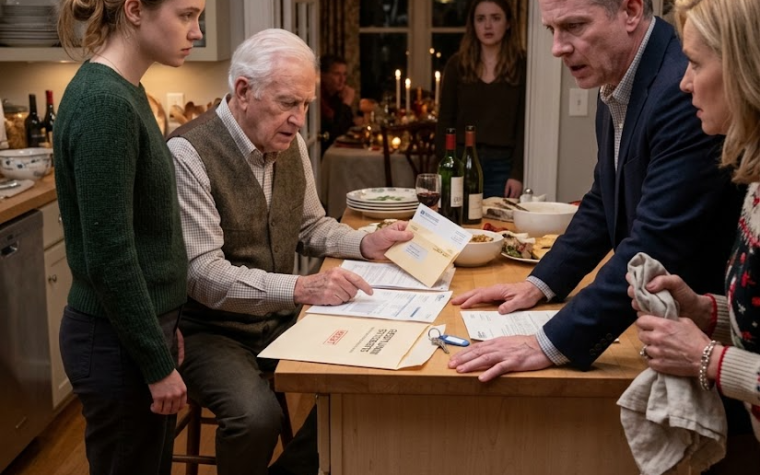
He had always been uncomfortable that I earned more than he did, though he enjoyed the life my salary helped provide.
Once our finances had to be disclosed formally, the private story he had told his parents—that he supported me and I contributed little—collapsed too.
The records were ordinary.
Pay statements.
Bank transfers.
Mortgage payments.
Household expenses.
Nothing dramatic.
But ordinary records can be devastating when someone has built their authority on a lie.
His mother had spent years telling relatives that I was lucky Ethan “allowed” me to have a career.
The numbers showed something very different.
I did not use them to humiliate him publicly.
I did not need to.
In court, facts did enough work on their own.
The hardest conversation came unexpectedly from my father-in-law.
Months after that night, through attorneys, he asked whether I would accept a written apology.
I almost refused to read it.
Then curiosity won.
He did not excuse himself.
He wrote that he had spent decades avoiding conflict with his wife and had taught Ethan, through silence, that keeping the dominant person happy mattered more than protecting the person being hurt.
He admitted that when he saw me on the kitchen floor, he knew I needed help.
He admitted he chose not to move.
The sentence that stayed with me was the shortest.
I was a witness, and I behaved like an accomplice.
I never wrote back.
Some apologies are meaningful without creating an obligation to restore the relationship.
Mrs.
Greene was different.
When I finally returned to thank her, she opened the door before I could knock twice.
For a second, we both looked at the patch of ground below her porch where she had found me.
Then she hugged me.
“I almost didn’t hear you,” she said.
“But you did.”
She shook her head.
“You got yourself here.
Remember that part.”
I did.
The divorce was finalized almost a year after the dinner that ended my marriage.
Ethan looked smaller in the courthouse hallway than he ever had inside his parents’ home.
Not physically smaller.
Just ordinary.
For years, I had experienced his certainty as power.
He decided what counted as disrespect.
He decided when I was overreacting.
He decided which insults were jokes and which objections required apologies.
Outside that system, he was simply a man facing the consequences of his own documented choices.
As we waited for our lawyers, he approached me one last time.
“Was it worth it?” he asked.
I knew exactly what he meant.
The police.
The separation.
The attorneys.
His mother’s case.
The family fractures.
The money.
The embarrassment.