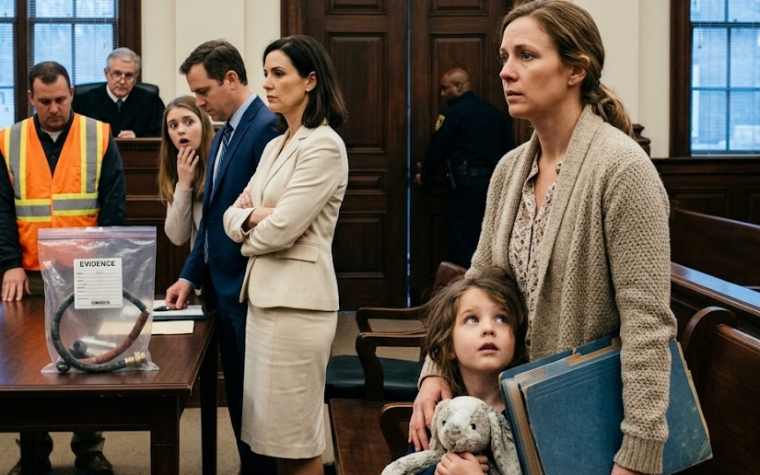
I held her gaze and did nothing.
“No further questions,” Daniel said.
Michael’s testimony went worse.
He denied making the suggestion that Grandma sell her home until Margaret produced contemporaneous notes from a meeting Grandma had scheduled the next morning.
He denied knowing the value of the estate until bank correspondence showed he had asked Grandma for account details.
He insisted the lawsuit was about fairness, then admitted under questioning that he and Patricia had already discussed using part of the inheritance to resolve their debts.
By late afternoon, their own testimony had supplied the motive missing from their petition.
They had not challenged the will because they believed Grandma lacked capacity.
They challenged it because she had said no.
Judge Whitmore took a brief recess to review the exhibits.
When he returned, no one spoke.
He began with the legal standard.
The burden rested on my parents to establish incapacity, undue influence, or another valid basis to invalidate the will.
They had failed.
He found that Grandma possessed testamentary capacity when she executed the documents.
Her intent had been independently recorded, medically supported, witnessed, and consistent across multiple meetings.
He found no evidence that I had pressured her.
Then his voice sharpened.
“The petitioners’ allegations concerning Lieutenant Colonel Mercer’s mental fitness were made without adequate factual foundation.
Their own testimony demonstrates that they possessed remarkably little knowledge of her professional life, financial competence, or relationship with the decedent.”
My mother’s face went blank.
Judge Whitmore continued.
“The court will not transform parental disappointment, entitlement, or estrangement into legal proof.”
He upheld Grandma’s will in full.
The $4.7 million estate remained mine.
He also denied my parents’ request to freeze the assets and ordered a separate hearing on attorney’s fees because portions of their petition appeared to have been pursued in bad faith.
Their lawyer leaned toward them immediately.
My father whispered, “What does that mean?”
It meant their attempt to exhaust me financially could cost them instead.
Outside the courtroom, reporters were not waiting.
There was no cheering crowd.
Real reversals are often quieter than people imagine.
There was only a marble hallway, the hum of fluorescent lights, and my parents standing several feet away as though they had arrived at the wrong ending.
My mother approached me one last time.
“You could have told us,” she said.
“About JAG?”
“About everything.”
I looked at the woman who had forgotten my law school graduation date, ignored my first promotion, and signed an affidavit calling me unstable without knowing the first thing about the life I had built.
“You could have asked,” I said.
She looked wounded by the answer.
My father said nothing.
He stared at the closed folders in Daniel’s hands.
I wondered whether he was thinking about Grandma, the money, or the legal fees.
Probably all three.
In the months that followed, the court ordered Patricia and Michael to reimburse a substantial portion of the estate’s costs.
Their attorney withdrew from further proceedings after they rejected his advice to settle.
They filed no appeal.
I did not celebrate their loss.
I transferred Grandma’s house into a trust and preserved the room where she kept her account ledgers and birthday cards.
I established a scholarship in her name for students entering public service and set aside funds for elder legal-aid programs that help families protect vulnerable relatives without stripping them of dignity.
The rest remained invested according to the plan Grandma had reviewed with her advisers.
My parents sent three letters.
The first blamed their lawyer.
The second blamed Grandma’s estate attorney.
The third said families should forgive one another.
None acknowledged the false claims.