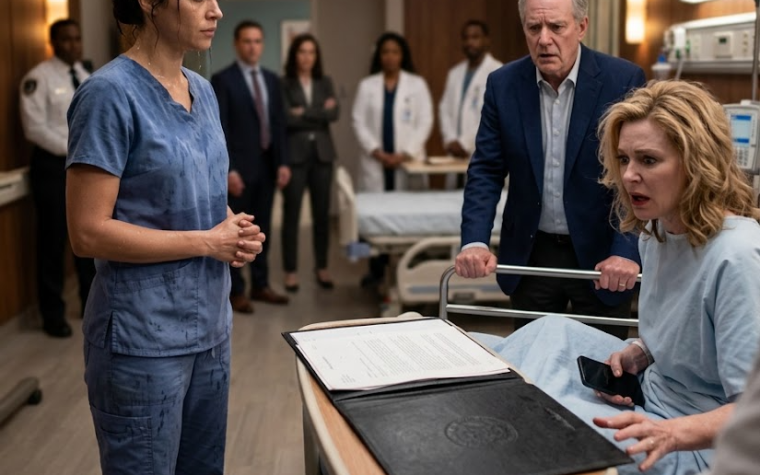
Rachel stared at the folder as if it had appeared from nowhere.
A few seconds earlier, she had been smiling.
Now her eyes were fixed on the first page beneath my hand.
“What is that?” she asked again.
I turned the folder toward myself before she could reach for it.
“Records.”
Dad exhaled sharply.
“Sarah, come on.”
“No,” I said.
“She wanted to talk about what she did.
We’re talking about it.”
Rachel recovered enough to roll her eyes.
“You requested paperwork from an insurance company.
Congratulations.
Very official.”
I had heard that tone from suspects before—not Rachel specifically, of course, but people who believed ridicule could shrink evidence into something harmless.
The first instinct was usually denial.
The second was minimization.
The third was blaming the person who noticed.
Rachel was moving quickly through all three.
I tapped the top page.
“After the insurance company called me, I disputed the beneficiary change immediately.
I told them I had never authorized it.
I also asked them to preserve the records connected to the request while they reviewed the impersonation.”
Mom’s face tightened.
“Impersonation sounds very dramatic.”
Rachel seized on that.
“Thank you.”
I looked at my mother.
“She called pretending to be me.”
Mom glanced toward Rachel.
“But she’s your sister.”
“That does not make her me.”
Dad pushed his plate away.
“This is ridiculous.
Rachel was trying to make sure the policy stayed in the family.”
“The policy was already mine to control.”
Rachel folded her arms.
“And you were doing nothing with it.”
“It’s life insurance.
Doing nothing with it while I’m alive is generally the preferred outcome.”
Dad almost smiled, then caught himself.
Rachel did not.
Her jaw hardened.
“You know what I mean.”
Unfortunately for her, I did.
For months she had stared at that policy as if it were a locked account containing half a million dollars instead of a death benefit that would only become payable under the policy’s terms after I died.
She had asked me to cancel it when she needed money, despite the fact that cancelling it would not have handed her a check.
Then she had suggested becoming my beneficiary.
When I said I would think about it, she had treated hesitation as authorization.
That was the part that interested me most.
Not because I needed to psychoanalyze her.
Because people revealed themselves through the permissions they invented.
Rachel had needed to believe she was entitled to decide for me.
So she created a version of the conversation in which I had practically agreed.
I slid one page from the folder.