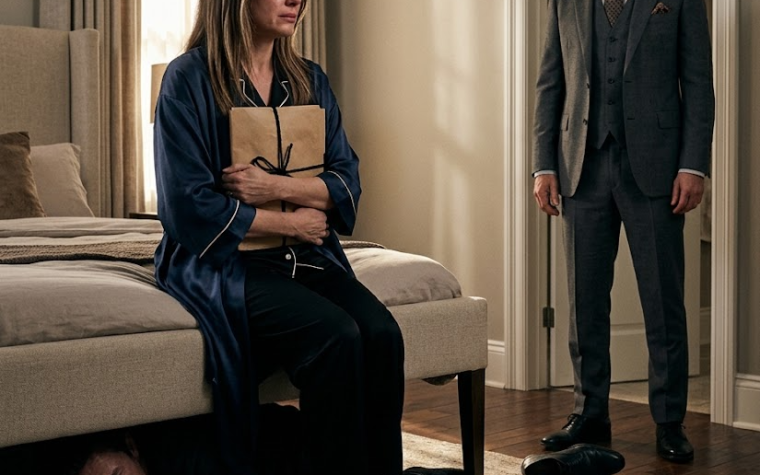
“None of this is your fault.”
“But it happened because I asked for shrimp.”
My throat tightened.
“No, sweetheart.
It happened because an adult chose to be cruel, and another adult finally chose not to allow it.”
She studied my face.
“You mean you?”
“I mean me.”
The board meeting began at nine the next morning.
Bennett arrived twenty minutes late with an attorney I had never met.
He wore a navy suit and the expression he used during difficult negotiations: calm, mildly offended, certain that charm would eventually restore his control.
The board members were already seated.
Nina sat beside our outside counsel, Julia Reese.
An independent forensic accountant joined by video.
I occupied the chair at the head of the table that Bennett had used for years.
He stopped when he saw me there.
“This is theatrical,” he said.
“Sit down,” I replied.
Julia presented the evidence in chronological order.
At first, Bennett denied everything.
He claimed the personal expenses were legitimate business development.
Margaret’s jewelry, he said, had been gifts for the spouses of foreign clients.
Walter’s cruise was supposedly a leadership retreat.
Caroline’s vacation property had been used for executive planning, though no employee had ever visited it.
Then Julia displayed the electronic approval logs.
The forged authorizations had originated from Bennett’s office computer.
The security system recorded him entering the building after midnight on several dates when I was traveling with the girls.
Nina produced emails in which Bennett instructed an assistant to process charges before I could review them.
One message read, Claire does not need to be bothered with details.
Another said, She signs whatever I put in front of her.
Bennett’s confidence began to crack.
He blamed his assistant.
The assistant had already provided a statement.
He blamed Nina.
Nina produced three written warnings she had sent him.
He blamed me.
“You left me to run everything,” he said.
“You enjoyed the income while I handled the pressure.”
“Running a company is not permission to steal from it.”
“I did not steal.
I supported my family.”
“With money that was not yours.”
He leaned toward me.
“Everything I did increased the appearance of success.
That image brought in clients.”
Julia closed one file and opened another.
“Then perhaps you can explain why you attempted to pledge Mrs.
Whitmore’s shares as collateral for a private loan.”
Even Bennett’s attorney turned toward him.
That was the evidence I had discovered three months earlier.
A lender had contacted me to confirm a guarantee on a six-million-dollar real estate project.
Bennett planned to develop luxury waterfront condominiums with two investors.
To secure the loan, he had represented himself as beneficial owner of my shares.
My signature appeared on the preliminary documents.
Again, it was not mine.
The deal had not closed, but the intent was clear.