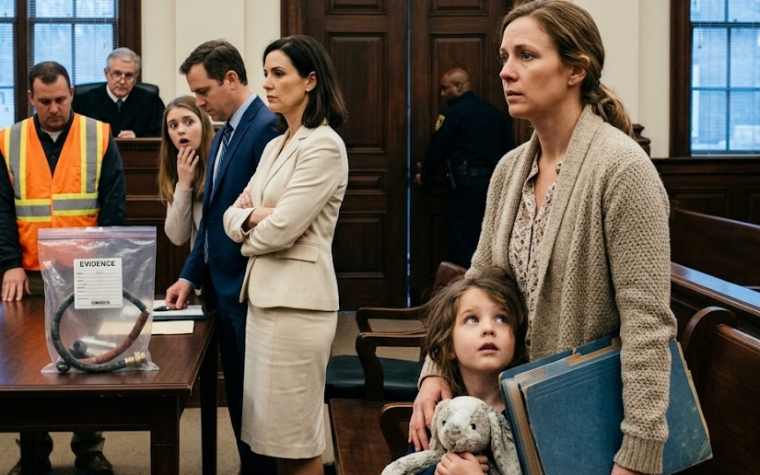
Judge Bennett read the first line of the retirement credential twice.
The courtroom was so quiet that I could hear the fluorescent light buzzing above the witness stand.
He looked at me over the rim of his glasses.
“Colonel Margaret Hayes?”
“Retired, Your Honor.”
Evelyn’s lead attorney turned toward me.
The confidence in his face did not disappear all at once.
It fractured slowly, like ice taking weight.
Judge Bennett looked back at the credential.
“United States Army Judge Advocate General’s Corps.
Twenty-four years of service.
Former senior litigation counsel in Stuttgart.”
Behind me, Anna released a breath that sounded almost like a sob.
Evelyn stared at me as though I had changed shape in front of her.
For two decades, she had known that I served in the Army.
Frank had told her that much when we married.
She assumed I handled paperwork on a base somewhere, perhaps wills for young soldiers or forms for officers transferring overseas.
I had never corrected her.
The truth was less convenient.
I had prosecuted procurement fraud, defended soldiers facing career-ending accusations, advised commanders through investigations, and spent years inside courtrooms where a misplaced date or an unsupported sentence could destroy a case.
In Stuttgart, I learned to remain still while witnesses shouted, commanders threatened, and highly paid civilian counsel tried to bury facts beneath performance.
Evelyn had spent years confusing my restraint with submission.
Her lawyers had made the same mistake in less than twenty minutes.
Judge Bennett placed the credential beside the deed.
“Mrs.
Hayes, do you intend to represent yourself?”
“Yes, Your Honor.”
The lead attorney stood.
“We were not informed that Mrs.
Hayes had legal training.”
I looked at him.
“You did not ask.”
A faint sound moved through the gallery.
Not laughter exactly, but the sharp exhale people make when arrogance receives its first unexpected answer.
The attorney’s jaw tightened.
“Her prior employment is irrelevant to the validity of the deed.”
“I agree,” I said.
“The dates are more relevant.”
Judge Bennett leaned forward.
I handed a copy of the county clerk’s receipt to the bailiff, who delivered it to the bench.
Another copy went to opposing counsel.
Evelyn’s lead attorney looked down.
His eyes stopped on the highlighted line.
The deed transferring Frank’s interest in the Smith Mountain Lake house to joint ownership with right of survivorship had not been recorded during chemotherapy.
It had been recorded three years before Frank’s diagnosis.
The clerk’s receipt showed the date, time, instrument number, book, and page.
The original deed carried the same information.
Frank had signed it before a notary.
The county had accepted it the next morning.
Mortgage records from the following month reflected both our names.
There had been no secret deathbed transfer.
There had been no confused patient signing away a family inheritance.
There had been a married couple arranging ownership of the home they had paid for together.
Judge Bennett turned to Evelyn’s lawyers.
“Counsel, your petition states that the deed was executed while Mr.
Hayes was undergoing chemotherapy.”