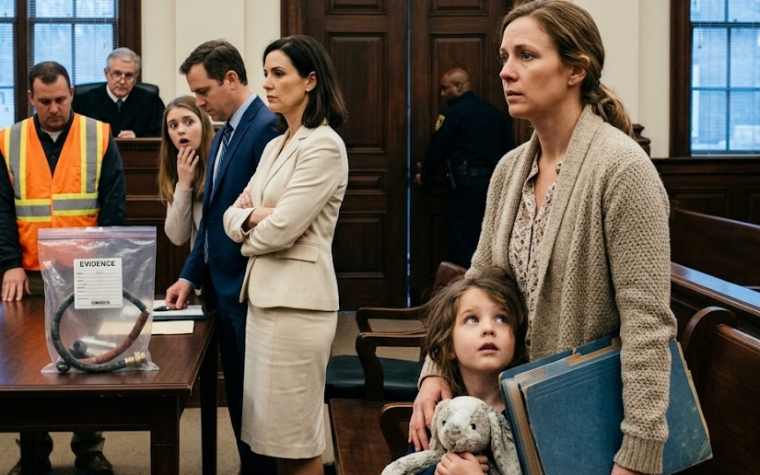
The attorney cleared his throat.
“That was the information provided by our client.”
“Did you examine the recording stamp?”
“We examined the instrument.”
“That was not my question.”
The attorney glanced at the two lawyers seated beside him.
One lowered her eyes to her legal pad.
The other began flipping through their exhibit binder with increasing speed.
“We may have relied upon a copy that did not clearly reproduce the stamp,” he said.
I opened my folder to the next tab.
“The copy attached to their own complaint reproduces it clearly, Your Honor.”
The courtroom went silent again.
Judge Bennett held out his hand.
The bailiff collected the complaint from me and brought it forward.
The judge compared the attachment with the clerk’s receipt.
The date was visible.
Not faint.
Not obscured.
Not missing.
Visible.
Evelyn leaned toward her attorney and whispered urgently.
He lifted one palm without looking at her, a subtle command to remain quiet.
She ignored it.
“That proves nothing,” she said.
“Frank never would have given her that house unless she pressured him.”
Judge Bennett’s gaze shifted toward her.
“Mrs.
Carter, you will speak through counsel unless called as a witness.”
“He was my son.”
“And this is my courtroom.”
Evelyn sat back.
Her face had begun to redden beneath her careful makeup.
The lead attorney tried to recover.
He argued that a deed could still be challenged for undue influence even if it predated the illness.
He suggested that Frank had always been vulnerable to me, that I managed the family finances, and that my legal experience created an imbalance of power inside the marriage.
It was a clever pivot.
In another case, with different facts, it might have created enough uncertainty to survive the hearing.
But Frank and I had spent twenty years documenting our lives because military families learn to keep records.
Orders, insurance forms, mortgage statements, beneficiary designations, deployment letters, powers of attorney—paper followed us everywhere.
I handed up twelve months of mortgage statements surrounding the transfer.
Every payment came from our joint account.
I provided the refinancing application signed by both of us.
It described the lake house as our marital residence and listed our combined income.
Then I submitted an email Frank had sent to the closing office three years before his illness.
The subject line was not important.
The sentence inside was.
He had asked the office to confirm that if either spouse died, the survivor would own the house without interruption.
There was no manipulation in the message.
No pressure.
No mention of illness.
Only a husband planning for the woman he expected to grow old beside.
Evelyn’s lead attorney read it with his lips pressed together.
Judge Bennett asked, “Does the petitioner dispute the authenticity of this email?”
The attorney requested a moment to confer.
All three lawyers leaned together.
Evelyn tried to join them, but the lead attorney whispered something that made her recoil.