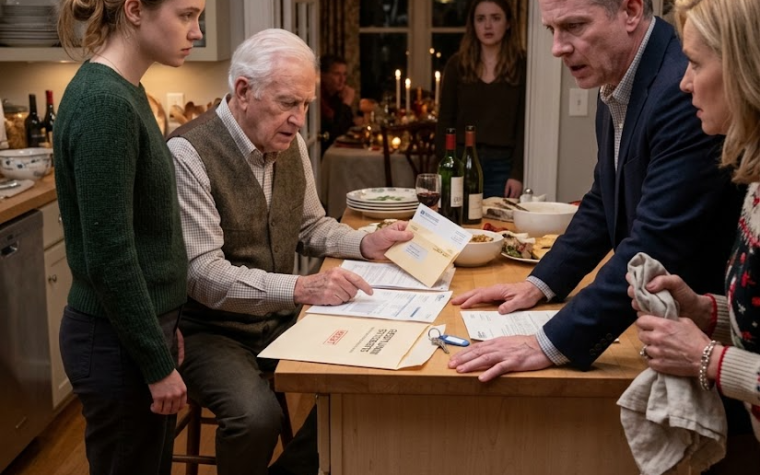
“I kept thinking I could fix it without losing anyone else.”
“You were willing to lose the truth.
You were willing to lose me.”
“I already did, didn’t I?”
I handed him the divorce papers Rebecca had prepared.
“Yes.”
He did not argue.
He signed them several days later.
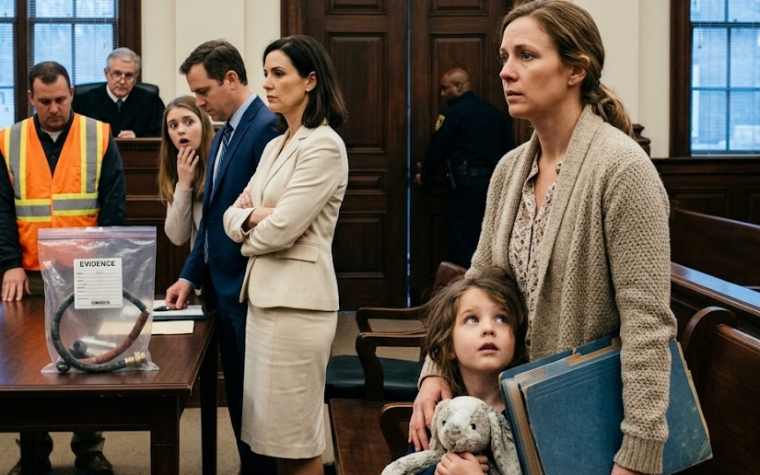
At the preliminary hearing, the prosecutor played only part of the patio recording.
That was enough.
Sharon sat at the defense table in a dark blue suit, her posture rigid and her expression carefully wounded.
Her attorney argued that she had reacted instinctively after I removed her hand.
He described the shove as minor and the outcome as unforeseeable.
My doctor testified that a forceful fall against the stone planter had caused the injury.
The nurse identified the photographs of my bruises.
A technician from the security company explained that the footage was original, continuous, and verified through server records.
Then Paula testified.
She admitted that Sharon had called my daughter a disappointment.
She repeated the sentence spoken minutes before the shove: “Let’s pray the next one is the boy this family actually deserves.”
For the first time, Sharon’s expression broke.
She turned toward Paula with open fury.
The prosecutor noticed.
“Mrs.
Brooks,” the judge warned, “face forward.”
Tyler testified last.
He admitted signing a false statement.
He admitted asking Sharon to delete the recording.
He admitted that his mother had conditioned financial help on his obedience for years.
Then the prosecutor showed him the restored message Sharon had sent after Lily died.
Maybe now you can start over properly and give this family a son.
Tyler began to cry before he could read it aloud.
Sharon stared straight ahead.
The judge ruled that there was sufficient evidence for the case to proceed.
After the hearing, Sharon was offered a plea agreement.
Her attorney advised her to accept it.
Instead, she rejected the first offer and insisted she would be vindicated at trial.
That confidence lasted until prosecutors disclosed the complete witness list, the cloud records, the medical testimony, and the restored messages.
They also planned to introduce her efforts to coordinate false statements after the incident.
Two weeks before trial, Sharon changed her plea.
She admitted to felony assault and evidence tampering.
In exchange, several lesser charges were dismissed.
The agreement did not allow her to describe the shove as an accident.
At sentencing, the courtroom was full.
Sharon’s attorney spoke about her church work, her age, and her lack of prior convictions.
Several friends submitted letters describing her generosity.
None mentioned Lily.
Then I stood to give my statement.
I did not tell the judge that Sharon had ruined my life.
She had changed it, but she would not own everything that came afterward.
I spoke about my daughter.
I described the healthy heartbeat on the ultrasound screen.
I described the way Lily moved when music played in the car.
I described the pink hat in the hospital box and the name Sharon had refused to say.
“My daughter was not a disappointment,” I said.
“She was wanted.
She was loved.