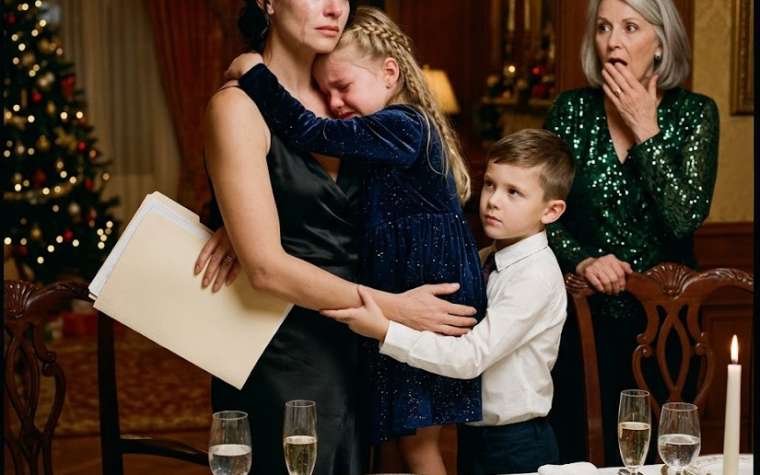
That evening, the girl stole a key ring and slipped into the warehouse carrying Nora.
She reached her mother’s room but could not open the heavy door while holding the baby.
An alarm sounded.
Maya ran toward the loading bay.
She pushed Nora beneath the descending metal door and tried to crawl after her.
The door struck Maya’s left arm before she pulled free.
She carried the baby through a drainage path, crossed a service road, and followed the sound of traffic because she believed the highway would lead to people the charity could not control.
Leah had spent the next hour pounding on the locked door.
The trooper called for medical assistance and secured the corridor.
Additional officers arrived within minutes.
They found four more women behind locked doors.
Each had been told a different version of the same lie: their children were being evaluated, a judge had approved the separation, or leaving would be treated as abandonment.
None of the women had seen a court order.
None had access to a phone.
The executive director arrived at the gate before the ambulances did.
He had persuaded the roadside officer that he needed to provide records.
Instead, he came with the charity’s attorney and demanded entry.
Daniel met him in the lobby.
The director’s composure returned when he saw the framed photographs and polished reception desk.
This was the environment he understood—a place where appearances could be arranged.
“These are confidential clients,” he said.
“You have no right to expose them.”
Daniel answered quietly.
“You exposed them when you locked the doors.”
The director insisted the locks protected residents from traffickers, violent partners, and self-harm.
He said Leah was delusional.
He said Maya’s injury proved why unsupervised children could not be trusted.
Then Leah entered the lobby with a blanket around her shoulders.
The director’s voice changed.
“You were supposed to sign the agreement by morning.”
The room went still.
His attorney closed his eyes.
The director realized what he had admitted and began talking faster.
He claimed he had meant a voluntary services agreement.
He accused a night supervisor of violating policy.
He said he had never visited the residential section.
Daniel opened the gala folder.
One of the photographs showed the director cutting a ribbon inside the same corridor three months earlier.
The temporary walls, camera housings, and numbered doors were visible behind him.
The caption called it HopeBridge’s secure family restoration wing.
The director looked at the photograph and said nothing.
The officers searched the records room after obtaining emergency authorization based on the injured child, the locked occupants, and the risk that evidence was being destroyed.
A shredder was still warm.
Two computers had been wiped minutes earlier, but the charity’s camera system stored copies on a separate recorder bolted beneath a desk.
The recordings showed mothers escorted into rooms and staff removing their phones.
They showed children taken through another hallway.
They showed the director walking through the facility repeatedly.
A second set of financial ledgers was hidden behind boxes labeled winter coats.
The public ledger listed donations spent on housing, counseling, food, and reunification services.
The private ledger tracked families as units of revenue.
Beside Maya’s family were three numbers: one for Leah, one for Maya, and one for Nora.
Each had been billed as a separate rescue.
Daniel found his foundation’s name on several pages.
HopeBridge had used Whitmore grants to cover the warehouse lease, security system, and staffing.
Money donated in Sarah’s memory had helped build the doors that trapped Leah.
Daniel walked outside and stood beneath the unlit silver sun.