For five years after Sarah’s death, he had believed writing checks was the opposite of doing nothing.
He now understood that money without attention could become a weapon in someone else’s hand.
The trooper joined him and said Leah wanted to go to the hospital.
Daniel drove there behind the ambulance.
Maya was sitting upright in a treatment room when he arrived.
Her arm had been set and covered in a bright blue cast.
Her feet were cleaned and bandaged.
Nora slept beneath a warming blanket, breathing more easily after treatment for exposure and dehydration.
Leah entered the room.
Maya stared at her for one stunned second.
Then she climbed from the bed.
Mother and daughter met in the space between the beds.
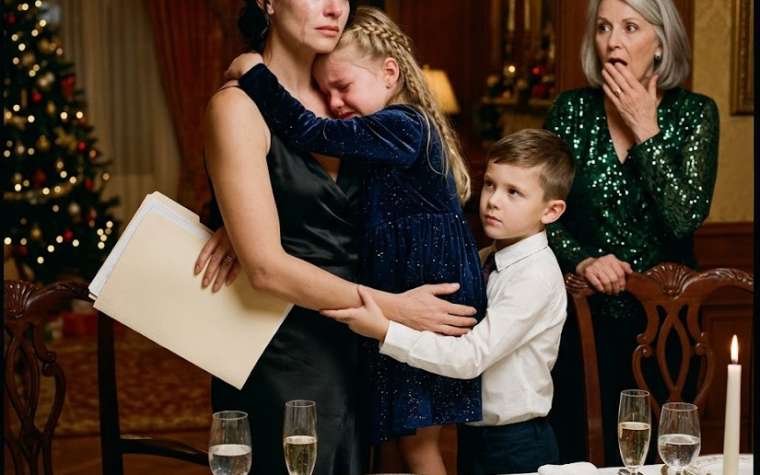
Leah dropped to her knees and wrapped her arms around Maya without touching the broken arm.
Maya pressed her face against her mother’s shoulder but did not cry immediately.
She had been too frightened for too long.
When the tears finally came, they were quiet.
Daniel stayed near the door.
Leah looked at him over Maya’s head.
“Are you the man from the pictures?”
Daniel nodded.
“I thought you knew,” she said.
The words contained no anger, which made them harder to bear.
“So did they,” Daniel replied.
By sunrise, HopeBridge’s accounts had been frozen.
Daniel contacted the foundation’s board, the property insurer, state regulators, and an independent attorney who had never worked for the charity.
He provided the lease, grant agreements, photographs, and every email his office had exchanged with the director.
He did not allow his staff to issue a statement praising his intervention.
The story did not belong to him.
The investigation lasted months.
Authorities identified dozens of falsified intake records and multiple families who had been separated under coercive agreements.
Several children had already entered foster placements after HopeBridge reported their parents missing or unfit.
Those cases were reopened.
The executive director was charged with fraud, unlawful restraint, evidence tampering, and conspiracy.
Two senior employees were charged with helping falsify records.
Other workers cooperated, describing a culture in which donor numbers mattered more than families and anyone who objected was threatened with dismissal.
HopeBridge’s board claimed it had been deceived.
Investigators found warning signs in internal reports that board members had ignored because fundraising continued to rise.
The charity was placed under independent control and eventually dissolved.
Its legitimate programs were transferred to organizations with licensed staff, outside oversight, and unrestricted access to advocates.
The warehouse never reopened as a shelter.
Daniel ordered every interior lock removed.
He sold the property and directed the proceeds toward legal support for the affected families.
The grants were administered by an independent panel that included parents who had once needed emergency housing themselves.
No organization receiving Whitmore funding could operate a residential program without unannounced inspections, confidential interviews with families, and a direct complaint line outside the charity’s control.
Daniel attended the first inspection personally.
He attended the next one too.
Six months after the night on I-75, Leah and her daughters moved into a small apartment near Maya’s school.
Leah found work in a medical laundry facility and began training for a supervisory position.
Nora recovered fully.
Maya’s arm healed, though cold weather sometimes made it ache.
One afternoon, Daniel received a package at his office.
Inside was the wool coat he had placed on the gravel.
It had been cleaned carefully.
A tear near the hem was repaired with pink thread.
There was no long letter, only a drawing from Maya.
It showed a dark road, a small girl, a baby, and a car with bright lights.