My sister had said there wasn’t enough space in her house.
The other sibling had worried that the children would not adjust to having Mom there while she was ill.
At the time, I had tried not to judge them.
People have jobs.
Families have limitations.
Homes have problems I might not know about.
So I had told myself not to be bitter.
I simply did what needed to be done.
But something had changed when the same people who could not make room for Mom began making room for suspicion.
They had found time for whispers.
Time to discuss her pension.
Time to wonder whether I was benefiting.
Time to suggest I was keeping everyone away because I wanted control of her money.
What they had not found was time to sit beside her bed on a difficult night.
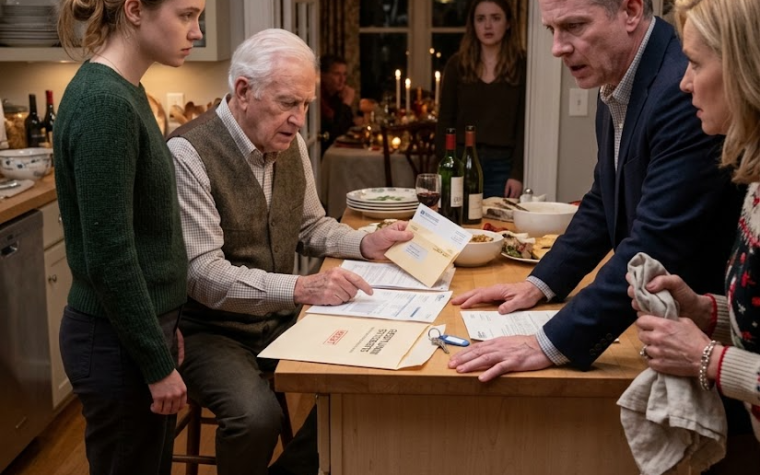
My brother tapped one of the papers with his finger.
“You could have asked us for money.”
I stared at him.
“I asked for help.”
“That’s not the same thing.”
“No.
It isn’t.”
He looked away.
I had asked for something more valuable than money.
I had asked for time.
Someone to stay with Mom while I worked.
Someone to accompany her to an appointment when I could not easily leave everything.
Someone to sit with her for a few hours so I could sleep without listening for footsteps from the next room.
Someone who knew her well enough to calm her when she became frightened or confused.
Money mattered, of course.
But illness turns ordinary life into a chain of tasks that cannot simply be paid away.
A prescription does not walk itself to the pharmacy.
A frightened mother does not comfort herself at two in the morning.
A woman who once dressed her children cannot always accept needing help dressing herself without shame.
Those moments require another human being.
Most of the time, that human being had been me.
My sister looked toward the hallway.
“How bad is she now?”
The question landed harder than the accusation had.
Not because it was cruel, but because it revealed how distant they had become.
They did not know.
They knew she was sick.
They knew she received a pension.
They knew enough to form opinions about money.
But they did not know how slowly she walked now.
They did not know how tired she became after a simple appointment.
They did not know which nights were worse.
They did not know how often she apologized for needing help.
They did not know how many times I had told her she had nothing to apologize for.
“She has good days and difficult ones,” I said.
“Lately there have been more difficult ones.”
My sister swallowed.
“And you’ve been doing everything alone?”
I almost said yes.
But that would not have been completely true.
Mom was still fighting too.
Even when her body failed her, she tried to make things easier for me.